Fornax A (NGC 1316)
Fornax A (NGC 1316) is a galaxy in the constellation Fornax, magnitude 8.5, 13′ × 7.7′ across.
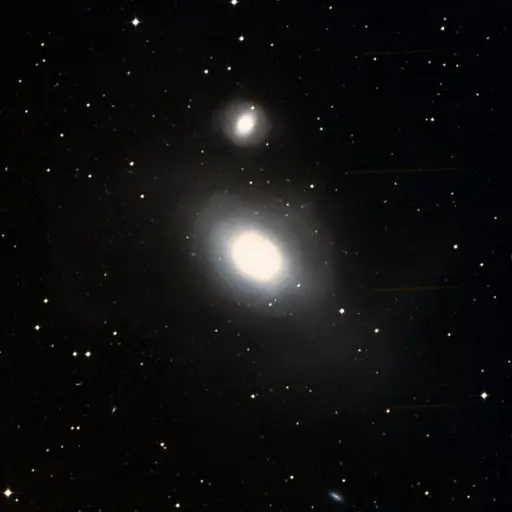
Fornax A: a galaxy built by swallowing others, and one of the brightest radio sources in the sky.
To a radio telescope, NGC 1316 is one of the loudest things in the sky: at 1400 MHz it is the fourth-brightest radio source of all. The power comes from a central black hole of around 140 million Suns, perhaps fed by the galaxies NGC 1316 has eaten.
In the late 1970s François Schweizer found ripples, loops and arcs in its outer glow, and dust lanes deep inside: the wreckage of several smaller galaxies it absorbed. The last big merger seems to have happened about 3 billion years ago. James Dunlop discovered this lenticular galaxy on 2 September 1826.
Fornax A (NGC 1316) is 70 million light-years away: the light we see from it set off about 70 million years ago, when dinosaurs still walked the Earth.
Did you know?
- On the edge. Giant galaxies like this usually sit at the centre of their cluster, as M 87 does in Virgo. Fornax A instead lies at the edge of the Fornax Cluster.
- Supernova factory. Four supernovae have been seen here since 1980. In 2006 Berto Monard found two, briefly visible at the same time; SN 2006dd became the brightest supernova of that year.
How big is it?
2.7 times as wide as our Milky Way. Light itself takes 270,000 years to cross it. Shrink it to the length of a football pitch and our whole Solar System would be smaller than a bacterium.
An 8.5-magnitude lenticular galaxy (S0) in Fornax, about 13′ × 7.7′.
When and where to see it
It is best placed in the evening sky around December, when it crosses the meridian at about 10 pm local time (around midnight in November). It can be seen from everywhere south of 53°N and never sets south of 53°S.
At its highest it stands 3° up from 50°N, 18° up from 35°N, 53° up from the equator, 88° up from 35°S.
Facts
- Type
- Galaxy
- Constellation
- Fornax
- Designations
- NGC 1316
- Magnitude
- 8.5
- Apparent size
- 13′ × 7.7′
- Position
- RA 3h 22.7m, Dec −37° 12′ (J2000)
- Distance
- 70 million light-years
- Discovered
- James Dunlop, 1826
Open AstroPilot to see when Fornax A (NGC 1316) is highest tonight from your location, how easy it is with your telescope or binoculars, and an eyepiece view.