NGC 1313
NGC 1313 is a galaxy in the constellation Reticulum, magnitude 9.5, 11′ × 9.1′ across.
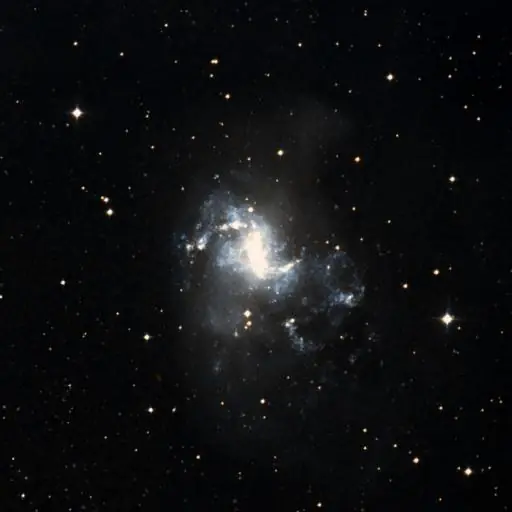
The Topsy Turvy Galaxy: lopsided, ragged and turning around a point that isn’t its centre.
Even its spin is off-centre. NGC 1313, the Topsy Turvy Galaxy, rotates around an axis that is not at its middle. It is a lopsided irregular galaxy, torn by bursts of star formation that blow great bubbles in its gas. A past collision would explain all this, yet NGC 1313 has no close neighbours. Perhaps it swallowed a small companion. James Dunlop discovered it on 27 September 1826.
NGC 1313 is 14 million light-years away: the light we see from it set off about 14 million years ago, when great apes were spreading through Africa and Europe.
Did you know?
- A supernova found 12 years late. In 1990 Stuart Ryder spotted an odd star here and reported it as a nova. Old photographs then showed it had erupted on 31 July 1978. It was a very unusual supernova, now called SN 1978K.
- A middleweight black hole. One of its two powerful X-ray sources, NGC 1313 X-1, is a rare intermediate-mass black hole: heavier than those left by single stars, far lighter than the giants in galaxy centres.
- Clusters that came apart. Young blue stars lie scattered all across the galaxy. They were born in clusters that quickly came “unglued”, spilling their stars out into the galaxy.
How big is it?
45% of the Milky Way’s width. Light itself takes 45,000 years to cross it. Shrink it to the length of a football pitch and our whole Solar System would be about the size of a red blood cell.
A 9.5-magnitude barred spiral galaxy (SBcd) in Reticulum, about 11′ × 9.1′.
When and where to see it
It is best placed in the evening sky around December, when it crosses the meridian at about 10 pm local time (around midnight in November). It can be seen from everywhere south of 24°N and never sets south of 24°S.
At its highest it stands below the horizon from 50°N, below the horizon from 35°N, 24° up from the equator, 59° up from 35°S.
Facts
- Type
- Galaxy
- Constellation
- Reticulum
- Designations
- NGC 1313
- Magnitude
- 9.5
- Apparent size
- 11′ × 9.1′
- Position
- RA 3h 18.3m, Dec −66° 30′ (J2000)
- Distance
- 14 million light-years
- Discovered
- James Dunlop, 1826
Open AstroPilot to see when NGC 1313 is highest tonight from your location, how easy it is with your telescope or binoculars, and an eyepiece view.