Perseus A (NGC 1275)
Perseus A (NGC 1275) is a galaxy in the constellation Perseus, magnitude 12.2, 2.2′ × 1.4′ across.
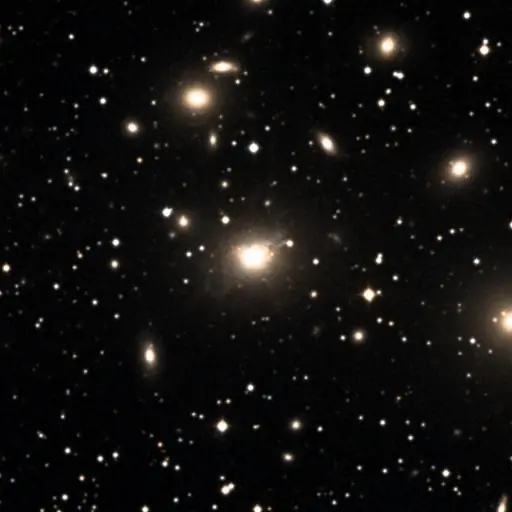
A giant galaxy at the heart of the Perseus Cluster, trailing threads of gas that may be held by magnetism.
Look at NGC 1275 and you are seeing two galaxies at once. Behind is the giant central galaxy of the Perseus Cluster. In front is a second galaxy, the ‘high velocity system’, plunging through the cluster at 3,000 kilometres a second. As it ploughs through the cluster’s gas it is being stripped and torn, sparking bursts of star formation.
The central giant has an active heart: its black hole and inner disc of gas weigh about 800 million suns. Rising bubbles of hot plasma from the core seem to drag out a web of glowing filaments, each holding about a million suns’ worth of gas, reaching out into the multimillion-degree gas that fills the cluster. Why these cool threads have not heated up, dispersed or collapsed into stars is a puzzle. William Herschel discovered NGC 1275 on 17 October 1786.
Perseus A (NGC 1275) is 220 million light-years away: the light we see from it set off about 220 million years ago, when dinosaurs were rising and the supercontinent Pangaea was breaking apart.
Did you know?
- Raining gas. Some 13 billion suns’ worth of molecular hydrogen seems to be falling into NGC 1275 from the surrounding cluster, feeding both its black hole and new stars.
- Held by gentle magnets?. One idea is that weak magnetic fields hold the filaments together — fields only about one ten-thousandth as strong as Earth’s.
How big is it?
1.4 times as wide as our Milky Way. Light itself takes 140,000 years to cross it. Shrink it to the length of a football pitch and our whole Solar System would be smaller than a bacterium.
The giant central galaxy of the Perseus Cluster and a powerful radio source (Perseus A); small telescopes show a faint smudge among other cluster galaxies.
When and where to see it
It is best placed in the evening sky around December, when it crosses the meridian at about 10 pm local time (around midnight in November). It can be seen from everywhere north of 48°S and never sets north of 48°N.
At its highest it stands 82° up from 50°N, 83° up from 35°N, 48° up from the equator, 13° up from 35°S.
Facts
- Type
- Galaxy
- Constellation
- Perseus
- Designations
- NGC 1275, C 24
- Magnitude
- 12.2
- Apparent size
- 2.2′ × 1.4′
- Position
- RA 3h 19.8m, Dec +41° 31′ (J2000)
- Distance
- 220 million light-years
- Discovered
- William Herschel, 1786
Open AstroPilot to see when Perseus A (NGC 1275) is highest tonight from your location, how easy it is with your telescope or binoculars, and an eyepiece view.