NGC 1269 (NGC 1291)
NGC 1269 (NGC 1291) is a galaxy in the constellation Eridanus, magnitude 8.7, 11′ × 9.9′ across.
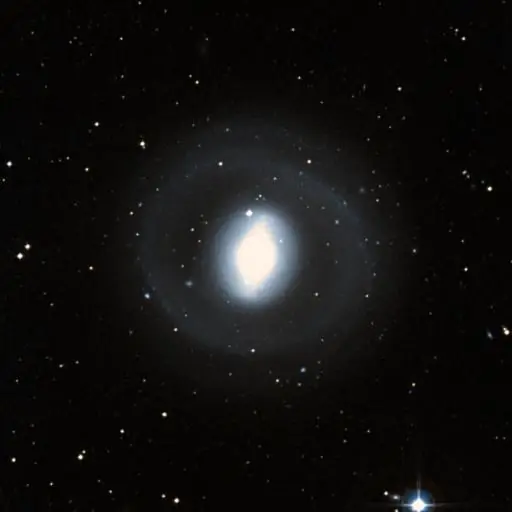
The Golden Eye Galaxy: a bar inside a ring, catalogued twice by mistake.
One galaxy, two NGC numbers. James Dunlop found it in 1826, and it entered the New General Catalogue as NGC 1291. John Herschel saw it again in 1836 and listed it as a new object, without realising it was the same one — so it is NGC 1269 as well. Today it is better known as the Golden Eye Galaxy.
Seen nearly face-on, it is a lenticular galaxy with a bright bulge and an unusual inner bar, circled far out by a faint ring where new stars are slowly forming. Its ringed shape is thought to be the legacy of a merger with a gas-rich galaxy long ago.
NGC 1269 (NGC 1291) is 32 million light-years away: the light we see from it set off about 32 million years ago, when the Himalayas and the Alps were rising.
Did you know?
- Caught in transition. In 2007 the team behind NASA’s Galaxy Evolution Explorer held it up as an example of a “transitional galaxy”: one caught between active star birth and a quiet old age.
How big is it?
About as wide as our Milky Way. Light itself takes 100,000 years to cross it. Shrink it to the length of a football pitch and our whole Solar System would be smaller than a bacterium.
An 8.7-magnitude lenticular galaxy (S0-a) in Eridanus, about 11′ × 9.9′.
When and where to see it
It is best placed in the evening sky around December, when it crosses the meridian at about 10 pm local time (around midnight in November). It can be seen from everywhere south of 49°N and never sets south of 49°S.
At its highest it stands below the horizon from 50°N, 14° up from 35°N, 49° up from the equator, 84° up from 35°S.
Facts
- Type
- Galaxy
- Constellation
- Eridanus
- Designations
- NGC 1291
- Magnitude
- 8.7
- Apparent size
- 11′ × 9.9′
- Position
- RA 3h 17.3m, Dec −41° 6′ (J2000)
- Distance
- 32 million light-years
- Discovered
- James Dunlop, 1826, John Herschel’s 1836 sighting became the duplicate entry NGC 1269
Open AstroPilot to see when NGC 1269 (NGC 1291) is highest tonight from your location, how easy it is with your telescope or binoculars, and an eyepiece view.