NGC 1232
NGC 1232 is a galaxy in the constellation Eridanus, magnitude 10.1, 6.8′ × 5.8′ across.
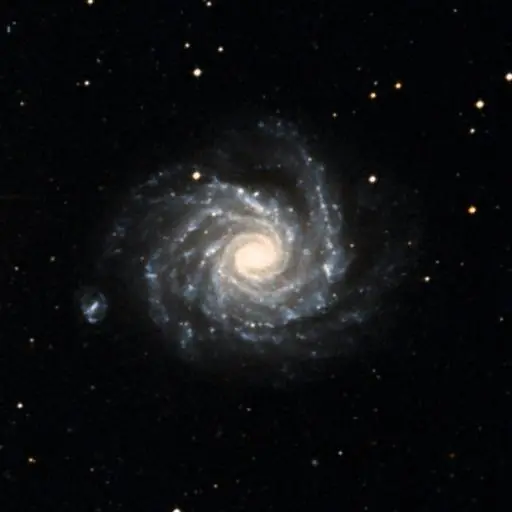
The Eye of God Galaxy: a face-on spiral of many arms, staring back across space.
Seen face-on, NGC 1232 looks like a great eye staring back at us, which is why it is called the Eye of God Galaxy. It is considered a prototype of the many-armed spiral galaxy: its arms are sprinkled with clusters of blue stars and glowing gas, with dark lanes of dust between. Beyond the starlight, unseen dark matter is needed to explain how its outer parts move.
The arms are not smooth. They bend abruptly, and Halton Arp suggested an encounter with another galaxy as the cause; others have proposed a collision with a dwarf galaxy, though some studies doubt it. William Herschel discovered it on 20 October 1784.
NGC 1232 is 46 million light-years away: the light we see from it set off about 46 million years ago, when mammals were taking over a world without dinosaurs.
Did you know?
- A companion that isn’t. The small galaxy NGC 1232A appears to hang beside it like a satellite, but its redshift does not match, so the two probably lie at different distances and have never interacted.
How big is it?
About as wide as our Milky Way. Light itself takes 91,000 years to cross it. Shrink it to the length of a football pitch and our whole Solar System would be smaller than a bacterium.
A 10.1-magnitude weakly barred spiral galaxy (SABc) in Eridanus, about 6.8′ × 5.8′.
When and where to see it
It is best placed in the evening sky around December, when it crosses the meridian at about 10 pm local time (around midnight in November). It can be seen from everywhere south of 69°N and never sets south of 69°S.
At its highest it stands 19° up from 50°N, 34° up from 35°N, 69° up from the equator, 76° up from 35°S.
Facts
- Type
- Galaxy
- Constellation
- Eridanus
- Designations
- NGC 1232
- Magnitude
- 10.1
- Apparent size
- 6.8′ × 5.8′
- Position
- RA 3h 9.8m, Dec −20° 35′ (J2000)
- Distance
- 46 million light-years
- Discovered
- William Herschel, 1784
Open AstroPilot to see when NGC 1232 is highest tonight from your location, how easy it is with your telescope or binoculars, and an eyepiece view.