NGC 1097 (C 67)
NGC 1097 (C 67) is a galaxy in the constellation Fornax, magnitude 9.8, 11′ × 6.4′ across.
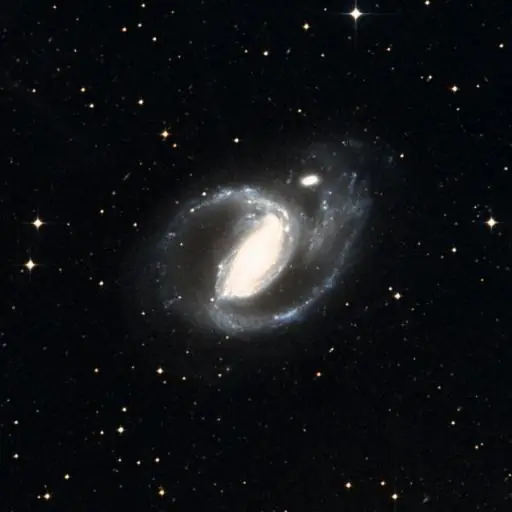
A barred spiral that has swallowed a dwarf galaxy, whose shredded remains streak out as four ghostly ‘jets’.
Deep photographs of NGC 1097 show four narrow streaks shooting out from its centre, like jets from a black hole — and at first astronomers took them for exactly that. But the streaks are made of stars, with no hydrogen gas. The best explanation is that they are the shattered remains of a dwarf galaxy that NGC 1097 has cannibalised.
This barred spiral galaxy is still feeding. At its centre a black hole of about 140 million suns is circled by a glowing ring of star-forming regions, with gas and dust spiralling inwards from the ring. Its companion galaxy NGC 1097A is close enough to have left tidal debris and distortions. William Herschel discovered NGC 1097 on 9 October 1790.
NGC 1097 (C 67) is 50 million light-years away: the light we see from it set off about 50 million years ago, when mammals were taking over a world without dinosaurs.
Did you know?
- Supernova hunting ground. Four supernovae have been seen in NGC 1097 since 1992. The latest, SN 2023rve, was discovered by Mohammad Odeh in August 2023.
- A hidden companion. A second satellite, the dwarf galaxy NGC 1097B, was found only through the radio glow of its hydrogen gas. Little else is known about it.
How big is it?
1.5 times as wide as our Milky Way. Light itself takes 150,000 years to cross it. Shrink it to the length of a football pitch and our whole Solar System would be smaller than a bacterium.
A barred spiral in Fornax with a bright nucleus and a long bar; it has a small elliptical companion.
When and where to see it
It is best placed in the evening sky around December, when it crosses the meridian at about 10 pm local time (around midnight in November). It can be seen from everywhere south of 60°N and never sets south of 60°S.
At its highest it stands 10° up from 50°N, 25° up from 35°N, 60° up from the equator, 85° up from 35°S.
Facts
- Type
- Galaxy
- Constellation
- Fornax
- Designations
- C 67
- Magnitude
- 9.8
- Apparent size
- 11′ × 6.4′
- Position
- RA 2h 46.3m, Dec −30° 16′ (J2000)
- Distance
- 50 million light-years
- Discovered
- William Herschel, 1790
Open AstroPilot to see when NGC 1097 (C 67) is highest tonight from your location, how easy it is with your telescope or binoculars, and an eyepiece view.