NGC 1027 (IC 1824)
NGC 1027 (IC 1824) is an open cluster in the constellation Cassiopeia, magnitude 6.7, 7.8′ across.
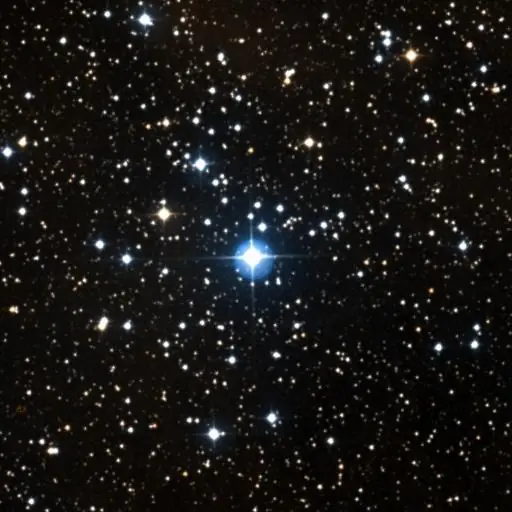
A cluster that seems to sit between the Heart and Soul nebulae — but lies well in front of them.
NGC 1027 appears between two of the great glowing clouds of Cassiopeia, the Heart and Soul nebulae. The arrangement is an illusion: this open cluster lies in the foreground, much nearer to us than either. Even the bright star in its middle is not a member. William Herschel discovered it in 1787, and it was later catalogued again as IC 1824.
NGC 1027 (IC 1824) is 3,500 light-years away: the light we see from it set off around 1480 BC, 150 years before Tutankhamun was buried in the Valley of the Kings.
How big is it?
Born about 190 million years ago, when dinosaurs were rising and the supercontinent Pangaea was breaking apart. Light itself takes 7.9 years to cross it. Gaia has picked out 562 stars moving together through space as its members. That’s 1.9 times the distance from the Sun to the nearest star. Shrink our Solar System — the Sun and all eight planets — to the size of a coin, and NGC 1027 would be 200 m across (2 football pitches end to end); the nearest star would be a football pitch away, and the Milky Way 2,520 km across.
A 6.7-magnitude open cluster in Cassiopeia, about 7.8′ across.
When and where to see it
It is best placed in the evening sky around December, when it crosses the meridian at about 10 pm local time (around midnight in November). It can be seen from everywhere north of 28°S and never sets north of 28°N.
At its highest it stands 78° up from 50°N, 63° up from 35°N, 28° up from the equator, below the horizon from 35°S.
Facts
- Type
- Open cluster
- Constellation
- Cassiopeia
- Designations
- IC 1824, Mel 16, Melotte 16
- Magnitude
- 6.7
- Apparent size
- 7.8′
- Position
- RA 2h 42.6m, Dec +61° 36′ (J2000)
- Distance
- 3,500 light-years
- Discovered
- William Herschel, 1787
Open AstroPilot to see when NGC 1027 (IC 1824) is highest tonight from your location, how easy it is with your telescope or binoculars, and an eyepiece view.