NGC 1023
NGC 1023 is a galaxy in the constellation Perseus, magnitude 9.5, 7.4′ × 3.1′ across.
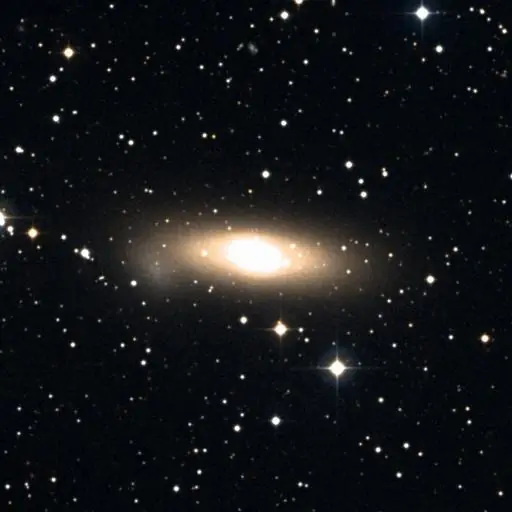
A smooth lenticular galaxy with a giant black hole, a small companion and a bridge of gas.
Nobody has seen the black hole at the heart of NGC 1023, but its pull is clear in the way stars move around the centre: about 44 million times the mass of the Sun. NGC 1023, also called the Perseus Lenticular Galaxy, is a barred lenticular galaxy and the main member of the NGC 1023 Group, which includes NGC 925.
Halton Arp listed it as Arp 135, among galaxies with nearby fragments. One fragment is its small satellite NGC 1023A, joined to it by a bridge of hydrogen gas — a sign the two may be interacting.
NGC 1023 is 37 million light-years away: the light we see from it set off about 37 million years ago, when the Himalayas and the Alps were rising.
Did you know?
- Big and small. Some 490 globular clusters orbit NGC 1023. Its little companion NGC 1023A has only about six.
How big is it?
80% of the Milky Way’s width. Light itself takes 80,000 years to cross it. Shrink it to the length of a football pitch and our whole Solar System would be smaller than a bacterium.
A 9.5-magnitude elliptical/lenticular galaxy (E-S0) in Perseus, about 7.4′ × 3.1′.
When and where to see it
It is best placed in the evening sky around December, when it crosses the meridian at about 10 pm local time (around midnight in November). It can be seen from everywhere north of 51°S and never sets north of 51°N.
At its highest it stands 79° up from 50°N, 86° up from 35°N, 51° up from the equator, 16° up from 35°S.
Facts
- Type
- Galaxy
- Constellation
- Perseus
- Designations
- NGC 1023
- Magnitude
- 9.5
- Apparent size
- 7.4′ × 3.1′
- Position
- RA 2h 40.4m, Dec +39° 4′ (J2000)
- Distance
- 37 million light-years
- Discovered
- William Herschel, 1786
Open AstroPilot to see when NGC 1023 is highest tonight from your location, how easy it is with your telescope or binoculars, and an eyepiece view.