Coma Star Cluster (Mel 111)
Coma Star Cluster (Mel 111) is an open cluster in the constellation Coma Berenices, 4.2° across.
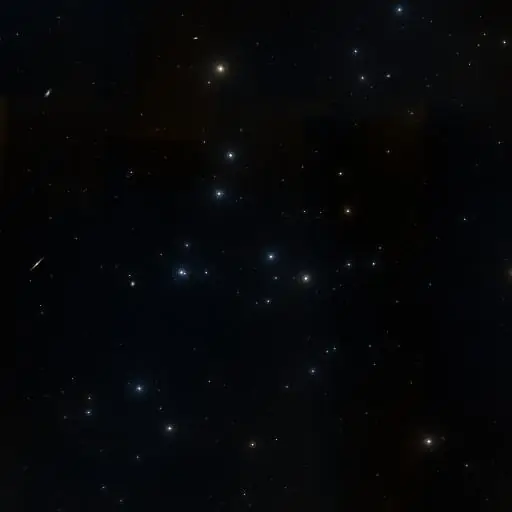
Once the tuft of Leo’s tail, then a queen’s sacrificed hair: one of the nearest star clusters to the Sun.
To ancient skywatchers this scattering of faint stars was the tuft at the end of Leo’s tail. Then, around 240 BC, it was renamed after Queen Berenice II of Egypt, wife of Ptolemy III. Legend says she vowed her hair to the gods for her husband’s safe return from war; when the offering vanished from the temple, it was said to have been placed among the stars. Hence the constellation’s name, Coma Berenices — Berenice’s Hair.
The open cluster is about 450 million years old, and its brighter stars are true siblings, moving through space together.
Coma Star Cluster (Mel 111) is 280 light-years away: the light we see from it set off around 1745, 25 years before Charles Messier published his famous catalogue.
Did you know?
- A rung on the cosmic ladder. Hipparcos and infrared studies measured its distance independently and got the same answer, making the cluster an important rung on the cosmic distance ladder.
How big is it?
Born about 650 million years ago, when there were no animals on Earth at all. Light itself takes 21 years to cross it. Gaia has picked out 271 stars moving together through space as its members. That’s 4.9 times the distance from the Sun to the nearest star. Shrink our Solar System — the Sun and all eight planets — to the size of a coin, and the Coma Star Cluster would be 521 m across (5 football pitches end to end); the nearest star would be a football pitch away, and the Milky Way 2,520 km across.
An open cluster in Coma Berenices, about 4.2° across.
When and where to see it
It is best placed in the evening sky around April, when it crosses the meridian at about 10 pm local time (around midnight in March). It can be seen from everywhere north of 64°S and never sets north of 64°N.
At its highest it stands 66° up from 50°N, 81° up from 35°N, 64° up from the equator, 29° up from 35°S.
Facts
- Type
- Open cluster
- Constellation
- Coma Berenices
- Designations
- Mel 111, Melotte 111
- Apparent size
- 4.2°
- Position
- RA 12h 25.1m, Dec +26° 6′ (J2000)
- Distance
- 280 light-years
- Discovered
- Known since antiquity
Open AstroPilot to see when Coma Star Cluster (Mel 111) is highest tonight from your location, how easy it is with your telescope or binoculars, and an eyepiece view.