Coma Pinwheel (M 99)
Coma Pinwheel (M 99) is a galaxy in the constellation Coma Berenices, magnitude 9.9, 5.0′ × 4.7′ across.
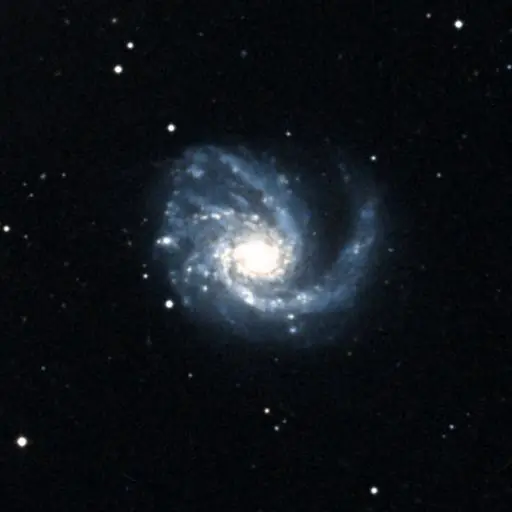
A lopsided pinwheel with one stretched arm — among the first galaxies ever seen to spiral.
In the spring of 1846 Lord Rosse turned his giant telescope in Ireland on a faint glow in Coma Berenices and saw it curl. M 99 became one of the first galaxies in which anyone saw a spiral pattern — long before anyone knew these spirals were whole other galaxies.
Pierre Méchain had found it on 17 March 1781 and passed it on to Charles Messier. Today we know it as a spiral galaxy falling into the Virgo Cluster, probably for the first time. As it ploughs through the cluster’s thin, hot gas, much of its own gas is being stripped away. It is also forming stars about three times faster than similar galaxies, perhaps stirred up by a close encounter.
Coma Pinwheel (M 99) is 54 million light-years away: the light we see from it set off about 54 million years ago, when mammals were taking over a world without dinosaurs.
Did you know?
- Stretched by a dark galaxy?. A bridge of hydrogen links M 99 to VIRGOHI21, a gas cloud that may be a ‘dark galaxy’ with almost no stars. Its pull may have stretched M 99’s long arm — or the cloud may just be debris from another encounter.
- Exploding and merging stars. Four supernovae have been seen in M 99 since 1967, the first found by Fritz Zwicky. In 2010 it also hosted a rarer outburst, a luminous red nova, thought to mark two stars merging.
How big is it?
79% of the Milky Way’s width. Light itself takes 79,000 years to cross it. Shrink it to the length of a football pitch and our whole Solar System would be smaller than a bacterium.
A face-on spiral in the Virgo Cluster with one longer, distorted arm; medium telescopes show a round glow with a hint of spiral structure.
When and where to see it
It is best placed in the evening sky around April, when it crosses the meridian at about 10 pm local time (around midnight in March). It can be seen from everywhere north of 76°S and never sets north of 76°N.
At its highest it stands 54° up from 50°N, 69° up from 35°N, 76° up from the equator, 41° up from 35°S.
Facts
- Type
- Galaxy
- Constellation
- Coma Berenices
- Designations
- M 99, NGC 4254, Virgo Cluster Pinwheel, St. Catherine's Wheel
- Magnitude
- 9.9
- Apparent size
- 5.0′ × 4.7′
- Position
- RA 12h 18.8m, Dec +14° 25′ (J2000)
- Distance
- 54 million light-years
- Discovered
- Pierre Méchain, 1781
Open AstroPilot to see when Coma Pinwheel (M 99) is highest tonight from your location, how easy it is with your telescope or binoculars, and an eyepiece view.