M 98 (NGC 4192)
M 98 (NGC 4192) is a galaxy in the constellation Coma Berenices, magnitude 10.1, 11′ × 2.7′ across.
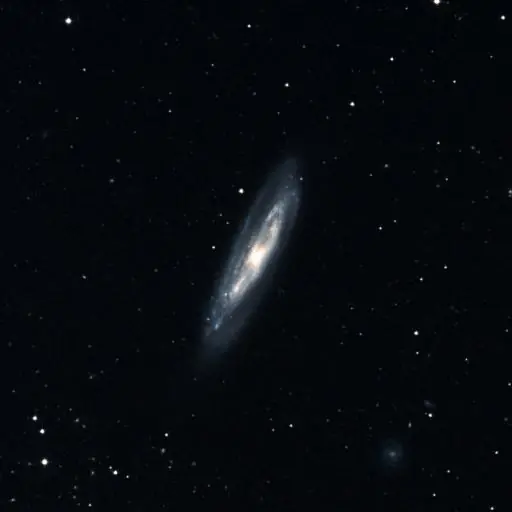
A hidden heavyweight: a spiral of some 76 billion suns, tipped steeply away from our view.
Tipped steeply to our line of sight, M 98 hides most of its spiral pattern. Yet it is a heavyweight: its stars add up to about 76 billion suns, and it holds more than 4 billion suns’ worth of hydrogen gas and 85 million suns’ worth of dust. Its stars whirl around the centre at up to 236 kilometres a second.
Pierre Méchain found this spiral galaxy in 1781, along with its neighbours M 99 and M 100, and Charles Messier logged it 29 days later. All three are members of the Virgo Cluster, a huge city of galaxies.
M 98 (NGC 4192) is 55 million light-years away: the light we see from it set off about 55 million years ago, when mammals were taking over a world without dinosaurs.
Did you know?
- Against the flow. Most galaxies are moving away from us as the universe expands. M 98’s light is blueshifted instead: its motion within the Virgo Cluster carries it towards us at about 140 km/s.
- A brush with M 99. About 750 million years ago M 98 may have passed close to the big spiral M 99. Today the two galaxies are far apart, both drifting within the Virgo Cluster.
How big is it?
1.8 times as wide as our Milky Way. Light itself takes 180,000 years to cross it. Shrink it to the length of a football pitch and our whole Solar System would be smaller than a bacterium.
A nearly edge-on spiral in Coma Berenices that appears as a long, faint streak; it is approaching us.
When and where to see it
It is best placed in the evening sky around April, when it crosses the meridian at about 10 pm local time (around midnight in March). It can be seen from everywhere north of 75°S and never sets north of 75°N.
At its highest it stands 55° up from 50°N, 70° up from 35°N, 75° up from the equator, 40° up from 35°S.
Facts
- Type
- Galaxy
- Constellation
- Coma Berenices
- Designations
- NGC 4192
- Magnitude
- 10.1
- Apparent size
- 11′ × 2.7′
- Position
- RA 12h 13.8m, Dec +14° 54′ (J2000)
- Distance
- 55 million light-years
- Discovered
- Pierre Méchain, 1781
Open AstroPilot to see when M 98 (NGC 4192) is highest tonight from your location, how easy it is with your telescope or binoculars, and an eyepiece view.