Owl Nebula (M 97)
Owl Nebula (M 97) is a planetary nebula in the constellation Ursa Major, magnitude 9.9, 3.4′ × 3.3′ across.
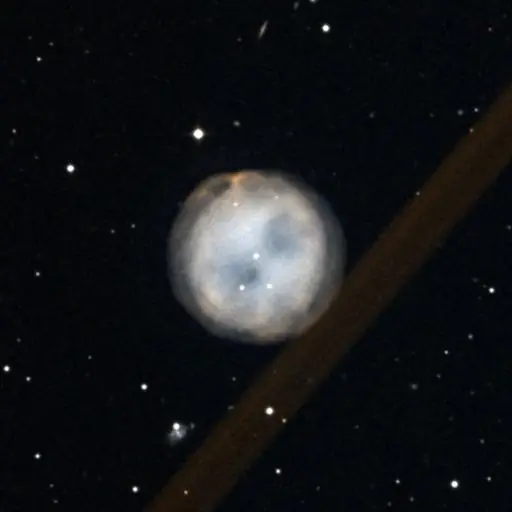
A dying star’s cast-off shells, shaped like an owl’s face — and named after Lord Rosse’s 1848 sketch.
About 8,000 years ago, a star near the end of its life began to shed its outer layers. The gas spread into three nested shells, and today they glow as a planetary nebula. The star left behind is a scorching 123,000 degrees and is shrinking into a white dwarf. The owl’s ‘eyes’ come from the inner shell, which is not round but a barrel tilted at 45 degrees to our line of sight.
Pierre Méchain discovered it on 16 February 1781, and Messier added it to his catalogue that March, noting that its light was faint. In 1844 Admiral William Smyth recognised it as a planetary nebula. Then in 1848 Lord Rosse, observing from Ireland, drew two stars, each in a dark patch. His sketch looked like an owl’s head, and the name has stuck ever since.
Owl Nebula (M 97) is 2,000 light-years away: the light we see from it set off around AD 30, around the time Vesuvius buried Pompeii.
Did you know?
- Almost nothing there. The whole nebula holds only about an eighth of the Sun’s mass, spread so thin that each cubic centimetre has fewer than 100 particles. The air you breathe has billions of billions.
- Still expanding. The Owl’s gas is spreading into space at 27 to 39 kilometres per second — fast enough to cross from London to New York in under four minutes.
How big is it?
2,080 Solar Systems side by side. Light itself takes 2 years to cross it. Shrink our Solar System — the Sun and all eight planets — to the size of a coin, and the Owl Nebula would be 49.9 m across (about the length of an Olympic pool); the nearest star would be a football pitch away, and the Milky Way 2,520 km across.
A large, round planetary nebula in Ursa Major whose two dark patches look like an owl's eyes in larger telescopes; an OIII filter helps. The edge-on galaxy M108 lies 48′ away.
When and where to see it
It is best placed in the evening sky around April, when it crosses the meridian at about 10 pm local time (around midnight in March). It can be seen from everywhere north of 35°S and never sets north of 35°N.
At its highest it stands 85° up from 50°N, 70° up from 35°N, 35° up from the equator, below the horizon from 35°S.
Facts
- Type
- Planetary nebula
- Constellation
- Ursa Major
- Designations
- M 97, NGC 3587
- Magnitude
- 9.9
- Apparent size
- 3.4′ × 3.3′
- Position
- RA 11h 14.8m, Dec +55° 1′ (J2000)
- Distance
- 2,000 light-years
- Discovered
- Pierre Méchain, 1781
Open AstroPilot to see when Owl Nebula (M 97) is highest tonight from your location, how easy it is with your telescope or binoculars, and an eyepiece view.