M 96 (NGC 3368)
M 96 (NGC 3368) is a galaxy in the constellation Leo, magnitude 9.2, 8.3′ × 5.5′ across.
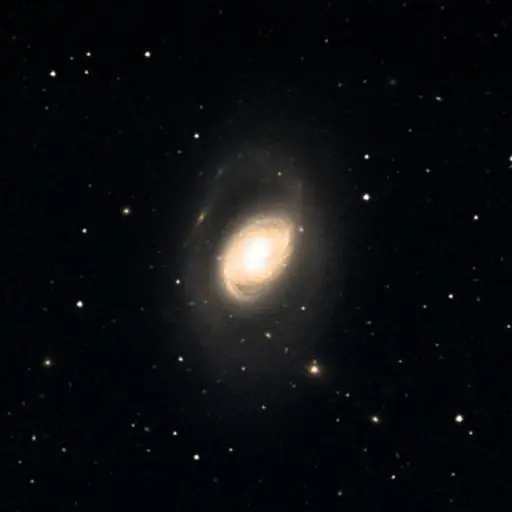
A lopsided twin of the Milky Way, where a 1998 supernova forged nearly half a Sun’s worth of iron.
Imagine the Milky Way pulled out of shape. M 96 has about the same mass and size as our own galaxy, but it is lopsided: its dust and gas are spread unevenly through weak spiral arms, and its core sits slightly off-centre. Astronomers think the tug of neighbouring galaxies is to blame.
Those neighbours include M 95 and M 105, fellow members of a group of galaxies in Leo. Pierre Méchain found M 96 on 20 March 1781, and Charles Messier confirmed it four days later. Flickers of ultraviolet light from its core hint at a supermassive black hole, and today it is one of 50 nearby galaxies studied by the LEGUS survey to learn how stars form.
M 96 (NGC 3368) is 34 million light-years away: the light we see from it set off about 34 million years ago, when the Himalayas and the Alps were rising.
Did you know?
- An iron foundry. In May 1998 Mirko Villi found supernova SN 1998bu in M 96. It became the brightest supernova of that year, and a year later its debris showed about 0.4 solar masses of freshly made iron.
- Two bars in one. M 96 is classed as a double-barred spiral: a small inner bar runs through its core, nested within a larger outer one.
- A rare mix. The M 96 Group is the nearest galaxy group to our own that combines bright spiral galaxies with a bright elliptical galaxy, M 105.
How big is it?
82% of the Milky Way’s width. Light itself takes 82,000 years to cross it. Shrink it to the length of a football pitch and our whole Solar System would be smaller than a bacterium.
The brightest galaxy of the Leo I Group, a spiral with an oval glow and a bright core, near M95 and M105.
When and where to see it
It is best placed in the evening sky around April, when it crosses the meridian at about 10 pm local time (around midnight in March). It can be seen from everywhere north of 78°S and never sets north of 78°N.
At its highest it stands 52° up from 50°N, 67° up from 35°N, 78° up from the equator, 43° up from 35°S.
Facts
- Type
- Galaxy
- Constellation
- Leo
- Designations
- NGC 3368
- Magnitude
- 9.2
- Apparent size
- 8.3′ × 5.5′
- Position
- RA 10h 46.8m, Dec +11° 49′ (J2000)
- Distance
- 34 million light-years
- Discovered
- Pierre Méchain, 1781
Open AstroPilot to see when M 96 (NGC 3368) is highest tonight from your location, how easy it is with your telescope or binoculars, and an eyepiece view.