M 94 (NGC 4736)
M 94 (NGC 4736) is a galaxy in the constellation Canes Venatici, magnitude 8.2, 7.7′ × 6.7′ across.
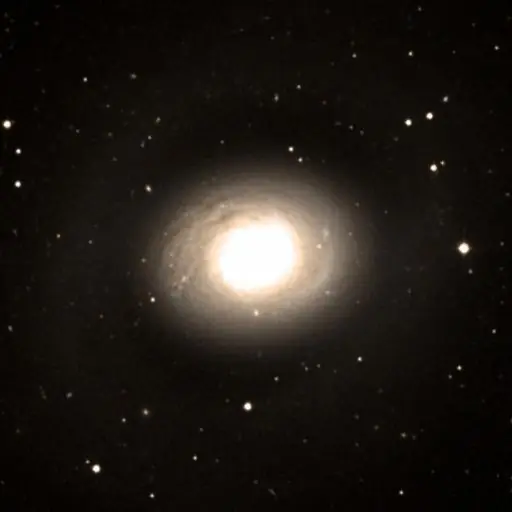
A galaxy with a blazing ring of newborn stars — and, puzzlingly, perhaps almost no dark matter.
In deep photographs M 94 stares back like an eye, which is why it is also called the Cat’s Eye or Crocodile Eye Galaxy. The bright ‘iris’ is a ring of intense star birth around the core, fed by gas that an oval, bar-like centre herds into it.
Further out lies a fainter outer ring. Seen in ultraviolet and infrared light, it turned out to be a lively disc of spiral arms that holds nearly a quarter of the galaxy’s mass in stars — and, star for star, makes new ones more efficiently than the inner disc.
Pierre Méchain discovered M 94 in 1781, and Charles Messier catalogued it two days later. At its heart sits a black hole of about 16 million suns, weighed using the James Webb Space Telescope.
M 94 (NGC 4736) is 15 million light-years away: the light we see from it set off about 15 million years ago, when great apes were spreading through Africa and Europe.
Did you know?
- Where is the dark matter?. A 2008 study found that ordinary stars and gas could account for all of M 94’s mass, leaving little or no room for dark matter. The result is controversial and has not been confirmed.
- A bulge that isn’t. Most spirals have a central bulge of old stars. M 94 has a ‘pseudobulge’ instead: a ring of young stars around an oval core that only looks like a bulge when seen face-on.
- Head of a loose family. M 94 is one of the brightest members of the M 94 Group, which holds 16 to 24 galaxies — although only a few of them seem to be held together by gravity.
How big is it?
34% of the Milky Way’s width. Light itself takes 34,000 years to cross it. Shrink it to the length of a football pitch and our whole Solar System would be about the size of a red blood cell.
A bright spiral with an intense inner ring of star formation; small telescopes show a bright oval core in a fainter halo.
When and where to see it
It is best placed in the evening sky around May, when it crosses the meridian at about 10 pm local time (around midnight in April). It can be seen from everywhere north of 49°S and never sets north of 49°N.
At its highest it stands 81° up from 50°N, 84° up from 35°N, 49° up from the equator, 14° up from 35°S.
Facts
- Type
- Galaxy
- Constellation
- Canes Venatici
- Designations
- NGC 4736, Crocodile Eye Galaxy, Cat's Eye Galaxy
- Magnitude
- 8.2
- Apparent size
- 7.7′ × 6.7′
- Position
- RA 12h 50.9m, Dec +41° 7′ (J2000)
- Distance
- 15 million light-years
- Discovered
- Pierre Méchain, 1781
Open AstroPilot to see when M 94 (NGC 4736) is highest tonight from your location, how easy it is with your telescope or binoculars, and an eyepiece view.