M 93 (NGC 2447)
M 93 (NGC 2447) is an open cluster in the constellation Puppis, magnitude 6.0, 22′ across.
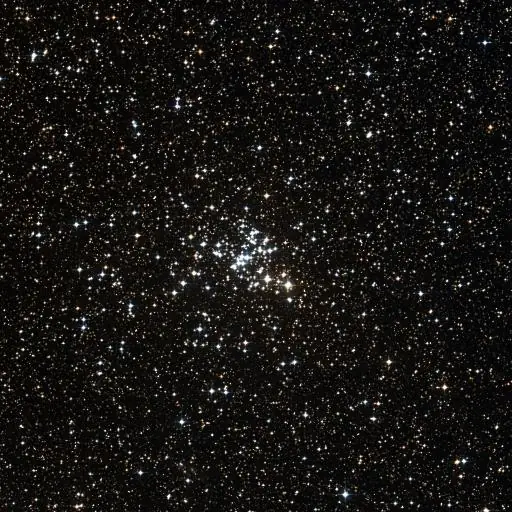
A swarm of stars on the stern of Jason’s ship Argo, born long before the first dinosaurs.
The constellation Puppis is the poop deck — the stern — of the Argo, the ship of Jason and the Argonauts, and M 93 rides on it. Charles Messier added this open cluster to his catalogue of comet-like objects in 1781. Two years later Caroline Herschel, William’s younger sister and a skilled comet hunter herself, found it again, thinking that Messier had not yet listed it.
Its stars were born around 387 million years ago, long before the first dinosaurs — youngsters next to the Sun, which is more than ten times older. It is sometimes called the Critter Cluster.
M 93 (NGC 2447) is 3,200 light-years away: the light we see from it set off around 1180 BC, 150 years after Tutankhamun was buried in the Valley of the Kings.
Did you know?
- One and a half laps. M 93 lies almost on the plane of the Milky Way and takes about 243 million years to orbit the galactic centre. Since its birth it has completed only about one and a half laps.
- A cluster of pulsing stars. Astronomers have found 54 variable stars in M 93, among them Delta Scuti and Gamma Doradus stars — stars that rhythmically brighten and fade as they pulsate.
How big is it?
Born about 580 million years ago, when there were no animals on Earth at all. Light itself takes 20 years to cross it. Gaia has picked out 1,043 stars moving together through space as its members. That’s 4.8 times the distance from the Sun to the nearest star. Shrink our Solar System — the Sun and all eight planets — to the size of a coin, and M 93 would be 517 m across (5 football pitches end to end); the nearest star would be a football pitch away, and the Milky Way 2,520 km across.
A bright, compact open cluster in Puppis whose brightest stars form a wedge or arrowhead.
When and where to see it
It is best placed in the evening sky around February, when it crosses the meridian at about 10 pm local time (around midnight in January). It can be seen from everywhere south of 66°N and never sets south of 66°S.
At its highest it stands 16° up from 50°N, 31° up from 35°N, 66° up from the equator, 79° up from 35°S.
Facts
- Type
- Open cluster
- Constellation
- Puppis
- Designations
- NGC 2447, Mel 76, Cr 160, Critter Cluster, Melotte 76, Collinder 160
- Magnitude
- 6.0
- Apparent size
- 22′
- Position
- RA 7h 44.5m, Dec −23° 51′ (J2000)
- Distance
- 3,200 light-years
- Discovered
- Charles Messier, 1781, Found again independently by Caroline Herschel in 1783
Open AstroPilot to see when M 93 (NGC 2447) is highest tonight from your location, how easy it is with your telescope or binoculars, and an eyepiece view.