M 91 (NGC 4548)
M 91 (NGC 4548) is a galaxy in the constellation Coma Berenices, magnitude 10.2, 5.5′ × 4.5′ across.
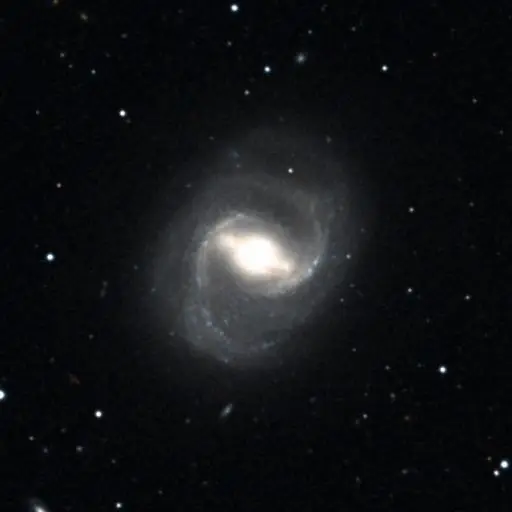
The Messier object that went missing for nearly two centuries, until an amateur cracked the case in 1969.
For almost two hundred years, one entry in Charles Messier’s catalogue pointed at empty sky. M 91 was the last of eight faint “nebulae” he found in Coma Berenices in 1781, logged as a nebula without stars, fainter than M 90. Yet nothing could be found at the position he gave.
The culprit was a bookkeeping slip. Messier had worked out its place from the galaxy M 58 when he should have used M 89. In 1969 amateur astronomer William C. Williams redid the sums from M 89 and landed on NGC 4548 — a barred spiral galaxy that William Herschel had catalogued in 1784. The match was almost perfect.
M 91 belongs to the Virgo Cluster, a vast swarm of galaxies. It is what astronomers call an anaemic spiral, with little gas left and few new stars being born.
M 91 (NGC 4548) is 63 million light-years away: the light we see from it set off about 63 million years ago, when mammals were taking over a world without dinosaurs.
Did you know?
- Swimming against the current. The Virgo Cluster as a whole is receding from us at about 1,100 km/s. M 91 is moving through it towards us at around 700 km/s, so it seems to recede at only about 400 km/s.
- Confirmed by pulsing stars. In 1997 measurements of Cepheid variables — stars whose pulsing rhythm reveals their true brightness — confirmed that M 91 really belongs to the Virgo Cluster.
How big is it?
About as wide as our Milky Way. Light itself takes 100,000 years to cross it. Shrink it to the length of a football pitch and our whole Solar System would be smaller than a bacterium.
A barred spiral in Coma Berenices, the faintest of the Messier galaxies; its bar shows as an elongated core.
When and where to see it
It is best placed in the evening sky around May, when it crosses the meridian at about 10 pm local time (around midnight in March). It can be seen from everywhere north of 76°S and never sets north of 76°N.
At its highest it stands 54° up from 50°N, 69° up from 35°N, 76° up from the equator, 41° up from 35°S.
Facts
- Type
- Galaxy
- Constellation
- Coma Berenices
- Designations
- NGC 4548
- Magnitude
- 10.2
- Apparent size
- 5.5′ × 4.5′
- Position
- RA 12h 35.4m, Dec +14° 30′ (J2000)
- Distance
- 63 million light-years
- Discovered
- Charles Messier, 1781
Open AstroPilot to see when M 91 (NGC 4548) is highest tonight from your location, how easy it is with your telescope or binoculars, and an eyepiece view.