M 90 (NGC 4569)
M 90 (NGC 4569) is a galaxy in the constellation Virgo, magnitude 9.5, 9.1′ × 3.8′ across.
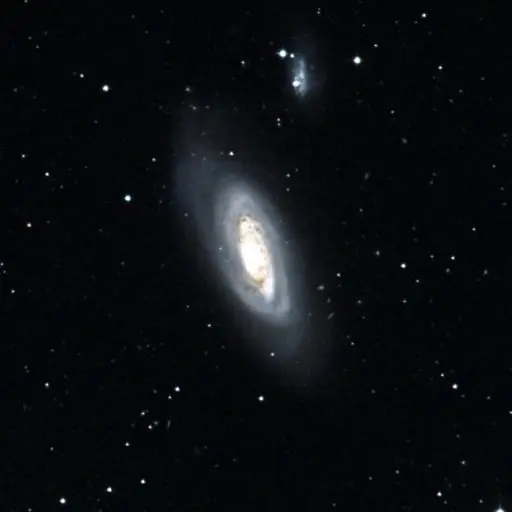
A great spiral being stripped bare as it races through the Virgo Cluster — while its core still blazes.
In true brightness M 90 outshines even the Andromeda Galaxy, and it is one of the largest spirals in the Virgo Cluster. But it is being stripped bare. As it races through the hot gas that fills the cluster, the headwind has torn away much of its own gas, leaving long tails of glowing gas behind and even a few star-forming clouds marooned outside its disc. With little fuel left, its arms look smooth and quiet, and M 90 has become a prototype of the “anaemic” spiral galaxy.
Its heart tells a different story. Around 50,000 hot, massive stars were born there only 5 to 6 million years ago, among supergiants left by earlier bursts. Supernovae in the nucleus — perhaps as many as 100,000 — have driven “superwinds” that blow gas out of the galaxy in two jets. Charles Messier found it in 1781.
M 90 (NGC 4569) is 50 million light-years away: the light we see from it set off about 50 million years ago, when mammals were taking over a world without dinosaurs.
Did you know?
- A misleading blueshift. M 90 is approaching us, which once suggested it lay in front of the Virgo Cluster. In fact, galaxies inside the cluster move so fast in all directions that some of them are heading our way.
- A false companion. The small galaxy IC 3583 was once thought to be M 90’s satellite. The two are now thought to be too far apart to interact at all.
- A thousand globulars. Around 1,000 globular clusters orbit M 90 — several times as many as the Milky Way has.
How big is it?
1.3 times as wide as our Milky Way. Light itself takes 130,000 years to cross it. Shrink it to the length of a football pitch and our whole Solar System would be smaller than a bacterium.
A large spiral in the Virgo Cluster that is approaching us; it appears as an elongated glow, and its gas-poor arms form few new stars.
When and where to see it
It is best placed in the evening sky around May, when it crosses the meridian at about 10 pm local time (around midnight in March). It can be seen from everywhere north of 77°S and never sets north of 77°N.
At its highest it stands 53° up from 50°N, 68° up from 35°N, 77° up from the equator, 42° up from 35°S.
Facts
- Type
- Galaxy
- Constellation
- Virgo
- Designations
- NGC 4569, Carabin Galaxy
- Magnitude
- 9.5
- Apparent size
- 9.1′ × 3.8′
- Position
- RA 12h 36.8m, Dec +13° 10′ (J2000)
- Distance
- 50 million light-years
- Discovered
- Charles Messier, 1781
Open AstroPilot to see when M 90 (NGC 4569) is highest tonight from your location, how easy it is with your telescope or binoculars, and an eyepiece view.