M 89 (NGC 4552)
M 89 (NGC 4552) is a galaxy in the constellation Virgo, magnitude 9.8, 8.1′ × 8.0′ across.
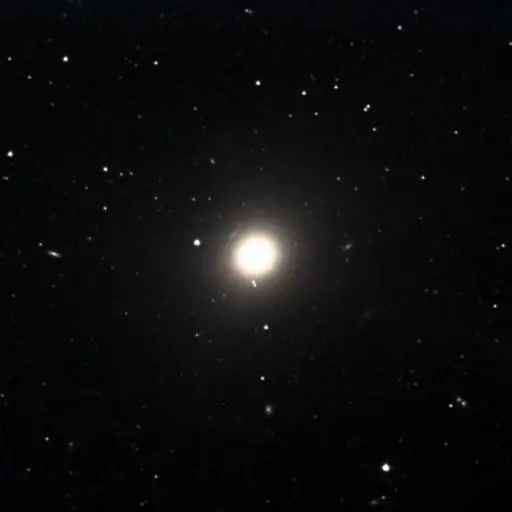
Perhaps the roundest galaxy known — with the fading signs of a wilder past.
Could a galaxy be a perfect sphere? M 89 may be one of the roundest known. Other galaxies of its kind that are close enough to measure easily all show some flattening; M 89 shows almost none. Either it really is a sphere, or it is an egg-shaped elliptical galaxy that happens to point straight at us. Charles Messier found it on 18 March 1781.
Its past was livelier than its smooth face suggests. A vast structure of gas and dust surrounds it, along with traces of jets — signs that it may once have blazed as a quasar or radio galaxy. Shells and plumes of stars point to one or more mergers. And X-ray images from Chandra show two rings of hot gas in its core, the mark of an outburst just 1 to 2 million years ago. A black hole of about 480 million suns sits at its centre.
M 89 (NGC 4552) is 52 million light-years away: the light we see from it set off about 52 million years ago, when mammals were taking over a world without dinosaurs.
Did you know?
- A swarm of globulars. A 2006 survey estimated about 2,000 globular clusters around M 89 — roughly ten times as many as orbit the Milky Way.
- Stripped as it goes. As M 89 moves through the Virgo Cluster’s hot gas, the headwind is stripping away some of its own gas.
How big is it?
1.2 times as wide as our Milky Way. Light itself takes 120,000 years to cross it. Shrink it to the length of a football pitch and our whole Solar System would be smaller than a bacterium.
An almost perfectly round elliptical galaxy in the Virgo Cluster, looking like a fuzzy star at low power.
When and where to see it
It is best placed in the evening sky around May, when it crosses the meridian at about 10 pm local time (around midnight in March). It can be seen from everywhere north of 77°S and never sets north of 77°N.
At its highest it stands 53° up from 50°N, 68° up from 35°N, 77° up from the equator, 42° up from 35°S.
Facts
- Type
- Galaxy
- Constellation
- Virgo
- Designations
- NGC 4552
- Magnitude
- 9.8
- Apparent size
- 8.1′ × 8.0′
- Position
- RA 12h 35.7m, Dec +12° 33′ (J2000)
- Distance
- 52 million light-years
- Discovered
- Charles Messier, 1781
Open AstroPilot to see when M 89 (NGC 4552) is highest tonight from your location, how easy it is with your telescope or binoculars, and an eyepiece view.