M 88 (NGC 4501)
M 88 (NGC 4501) is a galaxy in the constellation Coma Berenices, magnitude 9.6, 8.7′ × 4.4′ across.
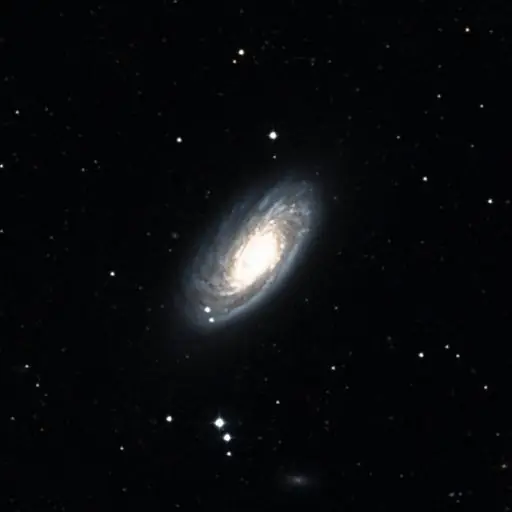
A graceful spiral on a plunging path towards the heart of the Virgo Cluster.
M 88 is falling. This spiral galaxy is on a long, stretched orbit that is carrying it almost straight towards the centre of the Virgo Cluster, where the giant galaxy M 87 sits. It will make its closest approach in about 200 to 300 million years. Charles Messier found it in 1781; it is one of fifteen Messier objects that belong to this great cluster.
The journey is already costing it. As M 88 pushes through the thin, hot gas between the galaxies, the pressure is stripping hydrogen from its outer edges — so far along its western, leading side. For now its arms remain neat and regular, and can be followed all the way into the core, where inflowing gas feeds a black hole of about 80 million suns.
M 88 (NGC 4501) is 64 million light-years away: the light we see from it set off about 64 million years ago, when mammals were taking over a world without dinosaurs.
Did you know?
- An active heart. M 88 is a Seyfert galaxy, its nucleus lit by highly ionised gas. Near the centre sits a dense knot of gas with two bright peaks, fed by material streaming in along the spiral arms.
- One of 2,096. The Virgo Cluster Catalogue lists 2,096 candidate member galaxies. M 88 is entry number 1401.
How big is it?
1.6 times as wide as our Milky Way. Light itself takes 160,000 years to cross it. Shrink it to the length of a football pitch and our whole Solar System would be smaller than a bacterium. It holds about 400 billion stars — the Milky Way has a few hundred billion.
A multi-arm spiral in the Virgo Cluster, tilted so that it shows an elongated oval with a bright core.
When and where to see it
It is best placed in the evening sky around May, when it crosses the meridian at about 10 pm local time (around midnight in March). It can be seen from everywhere north of 76°S and never sets north of 76°N.
At its highest it stands 54° up from 50°N, 69° up from 35°N, 76° up from the equator, 41° up from 35°S.
Facts
- Type
- Galaxy
- Constellation
- Coma Berenices
- Designations
- NGC 4501
- Magnitude
- 9.6
- Apparent size
- 8.7′ × 4.4′
- Position
- RA 12h 32.0m, Dec +14° 25′ (J2000)
- Distance
- 64 million light-years
- Discovered
- Charles Messier, 1781
Open AstroPilot to see when M 88 (NGC 4501) is highest tonight from your location, how easy it is with your telescope or binoculars, and an eyepiece view.