M 86 (NGC 4406)
M 86 (NGC 4406) is a galaxy in the constellation Virgo, magnitude 8.9, 12′ × 8.4′ across.
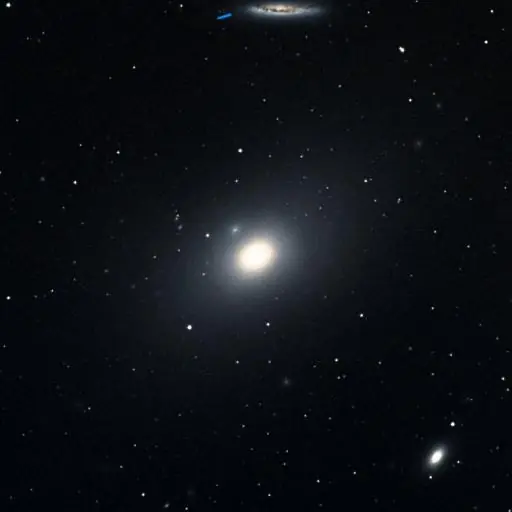
A giant galaxy heading our way — trailing a plume of hot gas as it plunges through the Virgo Cluster.
Almost every galaxy beyond our immediate neighbourhood is moving away from us, carried by the expansion of the universe. M 86 bucks the trend. It has the largest blueshift of any Messier object, closing in at about 244 km per second: its own plunge through the Virgo Cluster carries it towards us fast enough to overcome the cosmic expansion.
That speed comes at a price. As M 86 ploughs through the cluster’s hot gas, the headwind strips away its own gas, leaving a long trail of X-ray-bright gas that the Chandra telescope has traced. Filaments of glowing gas also link it to the badly disrupted spiral NGC 4438, from which M 86 may have pulled gas and dust. Charles Messier found this elliptical or lenticular galaxy in 1781.
M 86 (NGC 4406) is 55 million light-years away: the light we see from it set off about 55 million years ago, when mammals were taking over a world without dinosaurs.
Did you know?
- Eaten neighbours. M 86’s halo is threaded with streams of stars, thought to be the remains of small dwarf galaxies it has torn apart and absorbed.
- A crowd of globulars. Around 3,800 globular clusters orbit M 86 — roughly twenty times as many as the Milky Way has.
How big is it?
1.8 times as wide as our Milky Way. Light itself takes 180,000 years to cross it. Shrink it to the length of a football pitch and our whole Solar System would be smaller than a bacterium.
A large elliptical or lenticular galaxy in Markarian's Chain, close to M84; it is approaching us, one of the few galaxies with a blueshift.
When and where to see it
It is best placed in the evening sky around April, when it crosses the meridian at about 10 pm local time (around midnight in March). It can be seen from everywhere north of 77°S and never sets north of 77°N.
At its highest it stands 53° up from 50°N, 68° up from 35°N, 77° up from the equator, 42° up from 35°S.
Facts
- Type
- Galaxy
- Constellation
- Virgo
- Designations
- NGC 4406
- Magnitude
- 8.9
- Apparent size
- 12′ × 8.4′
- Position
- RA 12h 26.2m, Dec +12° 57′ (J2000)
- Distance
- 55 million light-years
- Discovered
- Charles Messier, 1781
Open AstroPilot to see when M 86 (NGC 4406) is highest tonight from your location, how easy it is with your telescope or binoculars, and an eyepiece view.