M 85 (NGC 4382)
M 85 (NGC 4382) is a galaxy in the constellation Coma Berenices, magnitude 9.1, 7.0′ × 5.3′ across.
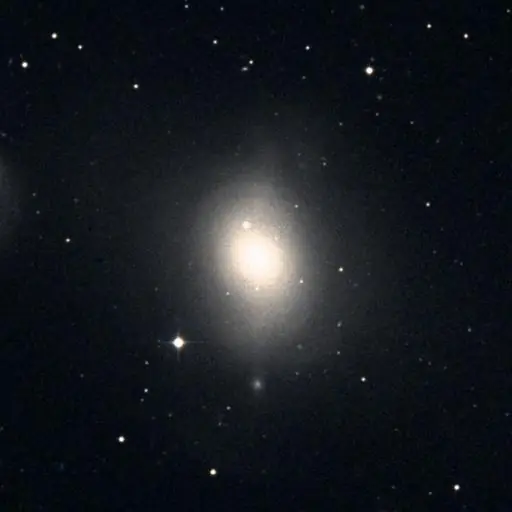
Scarred by an ancient merger — and home to the first luminous red nova ever identified.
At first glance M 85 is a smooth, featureless galaxy, somewhere between a lenticular and an elliptical. Look deeper and it is covered in scars: shells and ripples of stars in its outer parts, thought to be debris from a merger with another galaxy between 4 and 7 billion years ago. Pierre Méchain found it in 1781, on the northern outskirts of the Virgo Cluster.
That past still shapes it. Its centre holds stars under 3 billion years old, some arranged in a ring — perhaps from a late burst of star birth. The galaxy seems to be in the middle of a makeover, slowly turning from a lenticular into an elliptical. It has almost no cool hydrogen gas left, and it is still tangling with its neighbours: the spiral NGC 4394 and a small elliptical, MCG 3-32-38.
M 85 (NGC 4382) is 58 million light-years away: the light we see from it set off about 58 million years ago, when mammals were taking over a world without dinosaurs.
Did you know?
- A new kind of outburst. In January 2006 a strange red flare appeared on M 85’s outskirts. M85 OT2006-1 became the first object ever identified as a luminous red nova — a kind of outburst now thought to come from merging stars.
- A missing black hole?. Indirect methods suggest M 85 should hold a black hole of around 100 million suns. Yet measurements of its stars’ motions hint that it may have no central massive black hole at all.
- Clusters of many colours. Big galaxies like M 85 usually have red and blue families of globular clusters. M 85 has those, plus an in-between group and an even redder one.
How big is it?
1.2 times as wide as our Milky Way. Light itself takes 120,000 years to cross it. Shrink it to the length of a football pitch and our whole Solar System would be smaller than a bacterium.
A bright lenticular galaxy in Coma Berenices, the northernmost member of the Virgo Cluster; the barred spiral NGC 4394 lies nearby.
When and where to see it
It is best placed in the evening sky around April, when it crosses the meridian at about 10 pm local time (around midnight in March). It can be seen from everywhere north of 72°S and never sets north of 72°N.
At its highest it stands 58° up from 50°N, 73° up from 35°N, 72° up from the equator, 37° up from 35°S.
Facts
- Type
- Galaxy
- Constellation
- Coma Berenices
- Designations
- NGC 4382
- Magnitude
- 9.1
- Apparent size
- 7.0′ × 5.3′
- Position
- RA 12h 25.4m, Dec +18° 12′ (J2000)
- Distance
- 58 million light-years
- Discovered
- Pierre Méchain, 1781
Open AstroPilot to see when M 85 (NGC 4382) is highest tonight from your location, how easy it is with your telescope or binoculars, and an eyepiece view.