M 84 (NGC 4374)
M 84 (NGC 4374) is a galaxy in the constellation Virgo, magnitude 9.1, 7.4′ × 6.4′ across.
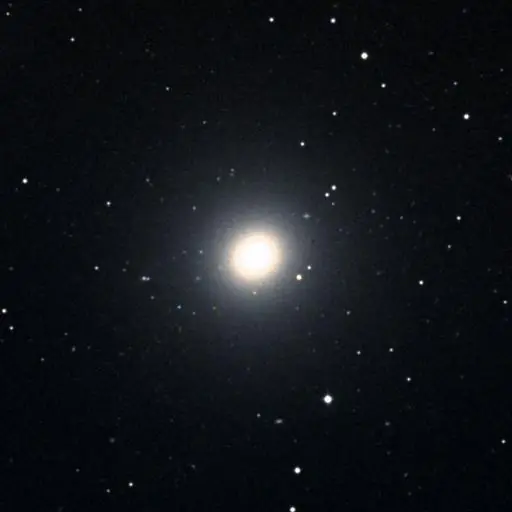
A quiet giant with a black hole of 1.5 billion suns — and a habit of unusual supernovae.
In 1781 Charles Messier, combing Virgo for nebulous objects, logged M 84 near what we now know is the crowded heart of the Virgo Cluster. It is a giant ball of mostly old stars — astronomers still debate whether to call it an elliptical or a lenticular — wrapped in a massive halo of dark matter.
Radio telescopes and Hubble have found two jets shooting from its centre, and a disc of gas and stars whirling around a black hole of about 1.5 billion suns. Galaxies like this are usually quiet, with almost no new stars forming. Yet three supernovae have been credited to M 84 — although one may belong to a neighbour — a rate that is rare for its kind and may mean it hides a population of middle-aged stars.
M 84 (NGC 4374) is 60 million light-years away: the light we see from it set off about 60 million years ago, when mammals were taking over a world without dinosaurs.
Did you know?
- A template explosion. SN 1991bg, spotted by eye by Reiki Kushida in December 1991, was an unusually faint Type Ia supernova. It became the template for a whole class, now called “91bg-like” supernovae.
- Fewer clusters than expected. M 84 has around 1,775 globular clusters — a lot by Milky Way standards, but far fewer than expected for a galaxy of its kind.
How big is it?
1.3 times as wide as our Milky Way. Light itself takes 130,000 years to cross it. Shrink it to the length of a football pitch and our whole Solar System would be smaller than a bacterium.
A lenticular galaxy at the heart of the Virgo Cluster, at the western end of Markarian's Chain next to M86.
When and where to see it
It is best placed in the evening sky around April, when it crosses the meridian at about 10 pm local time (around midnight in March). It can be seen from everywhere north of 77°S and never sets north of 77°N.
At its highest it stands 53° up from 50°N, 68° up from 35°N, 77° up from the equator, 42° up from 35°S.
Facts
- Type
- Galaxy
- Constellation
- Virgo
- Designations
- NGC 4374
- Magnitude
- 9.1
- Apparent size
- 7.4′ × 6.4′
- Position
- RA 12h 25.1m, Dec +12° 53′ (J2000)
- Distance
- 60 million light-years
- Discovered
- Charles Messier, 1781
Open AstroPilot to see when M 84 (NGC 4374) is highest tonight from your location, how easy it is with your telescope or binoculars, and an eyepiece view.