Southern Pinwheel Galaxy (M 83)
Southern Pinwheel Galaxy (M 83) is a galaxy in the constellation Hydra, magnitude 7.6, 14′ × 13′ across.
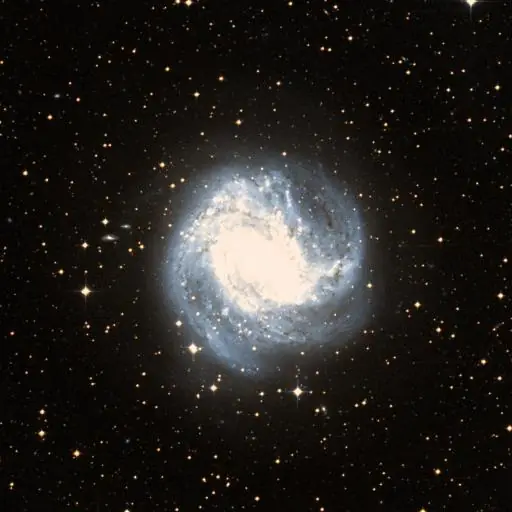
A grand southern spiral — and the home of a supernova that defined a whole class of exploding stars.
On 17 February 1752, at the Cape of Good Hope, Nicolas Louis de Lacaille noted a faint glow near the border of Hydra and Centaurus. Nearly thirty years later, in March 1781, Charles Messier added it to his catalogue. Today it is called the Southern Pinwheel, for its likeness to the Pinwheel Galaxy, M 101.
M 83 is a grand-design spiral galaxy with a weak bar, and it is busy making stars. They form most vigorously along the leading edges of its arms, just as the theory of spiral density waves predicts. In 2008 NASA’s GALEX satellite found young stars even in its far outskirts, where astronomers had thought the raw material for stars was missing. A brush with the dwarf galaxy NGC 5253 within the last billion years probably set off bursts of star birth at the centres of both.
Southern Pinwheel Galaxy (M 83) is 15 million light-years away: the light we see from it set off about 15 million years ago, when great apes were spreading through Africa and Europe.
Did you know?
- A supernova of firsts. Australian supernova hunter Robert Evans found SN 1983N here. It was the first Type I supernova detected in radio waves and the first to clearly show a large haul of freshly made iron, and it became the modern prototype of Type Ib.
- A hidden heart?. In April 2025 astronomers published the first clues that a supermassive black hole may lie at M 83’s centre.
- Two groups in one. M 83 anchors one half of the Centaurus A/M 83 Group of galaxies; the galaxies around Centaurus A form the other half, and the two subgroups barely move relative to each other.
How big is it?
59% of the Milky Way’s width. Light itself takes 59,000 years to cross it. Shrink it to the length of a football pitch and our whole Solar System would be smaller than a bacterium.
A bright, face-on barred spiral in Hydra; large telescopes show its bar and arms. Six supernovae have been seen in it.
When and where to see it
It is best placed in the evening sky around May, when it crosses the meridian at about 10 pm local time (around midnight in April). It can be seen from everywhere south of 60°N and never sets south of 60°S.
At its highest it stands 10° up from 50°N, 25° up from 35°N, 60° up from the equator, 85° up from 35°S.
Facts
- Type
- Galaxy
- Constellation
- Hydra
- Designations
- M 83, NGC 5236
- Magnitude
- 7.6
- Apparent size
- 14′ × 13′
- Position
- RA 13h 37.0m, Dec −29° 52′ (J2000)
- Distance
- 15 million light-years
- Discovered
- Nicolas Louis de Lacaille, 1752, Messier added it to his catalogue in 1781
Open AstroPilot to see when Southern Pinwheel Galaxy (M 83) is highest tonight from your location, how easy it is with your telescope or binoculars, and an eyepiece view.