Cigar Galaxy (M 82)
Cigar Galaxy (M 82) is a galaxy in the constellation Ursa Major, magnitude 8.4, 11′ × 5.1′ across.
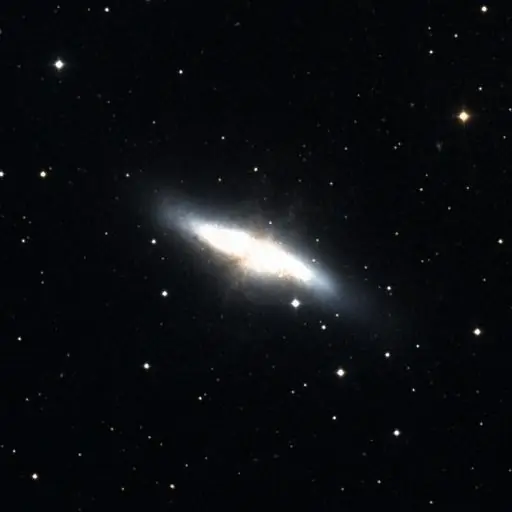
A galaxy in overdrive: stars born at a furious pace, and a wind of gas blasting out above and below.
Johann Elert Bode found M 82 alongside M 81 in 1774, describing a “nebulous patch”, “very pale and of elongated shape”. Seen almost edge-on, it does look like a cigar. But this is a galaxy in overdrive. Its centre is forming stars about ten times faster than the whole Milky Way, making M 82 the classic example of a starburst galaxy.
The trigger was its big neighbour, M 81. Close passages over the past few hundred million years funnelled gas into M 82’s core, where Hubble has counted 197 massive young star clusters. The heaviest stars there live fast and die young: in the busiest clumps a supernova goes off roughly once a decade, and together these blasts drive a “superwind” that blows gas out of the galaxy.
Cigar Galaxy (M 82) is 13 million light-years away: the light we see from it set off about 13 million years ago, when great apes were spreading through Africa and Europe.
Did you know?
- A spiral in disguise. M 82 was long classed as an irregular galaxy. In 2005 near-infrared images revealed two symmetric spiral arms, hidden until then by dust and our nearly edge-on view.
- A supernova found in class. On 21 January 2014 lecturer Steve Fossey and four of his students at the University of London Observatory spotted a new star in M 82. SN 2014J was the closest Type Ia supernova since 1972.
- The unexplained object. In 2010 radio astronomers at Jodrell Bank found an object in M 82 unlike anything seen before. Its material appears to move four times faster than light — an illusion of a jet aimed close to our line of sight. No theory fully explains it.
- Record-breaking pulsar. In 2014 astronomers studying M 82 discovered M82 X-2, the brightest pulsar then known.
How big is it?
42% of the Milky Way’s width. Light itself takes 42,000 years to cross it. Shrink it to the length of a football pitch and our whole Solar System would be about the size of a red blood cell.
A starburst galaxy seen edge-on, slender and mottled by dust lanes; its burst of star formation was triggered by a close encounter with M81.
When and where to see it
It is best placed in the evening sky around March, when it crosses the meridian at about 10 pm local time (around midnight in February). It can be seen from everywhere north of 20°S and never sets north of 20°N.
At its highest it stands 70° up from 50°N, 55° up from 35°N, 20° up from the equator, below the horizon from 35°S.
Facts
- Type
- Galaxy
- Constellation
- Ursa Major
- Designations
- M 82, NGC 3034
- Magnitude
- 8.4
- Apparent size
- 11′ × 5.1′
- Position
- RA 9h 55.9m, Dec +69° 41′ (J2000)
- Distance
- 13 million light-years
- Discovered
- Johann Elert Bode, 1774, Méchain found it again in 1779 and told Messier
Open AstroPilot to see when Cigar Galaxy (M 82) is highest tonight from your location, how easy it is with your telescope or binoculars, and an eyepiece view.