Bode's Galaxy (M 81)
Bode's Galaxy (M 81) is a galaxy in the constellation Ursa Major, magnitude 6.9, 22′ × 11′ across.
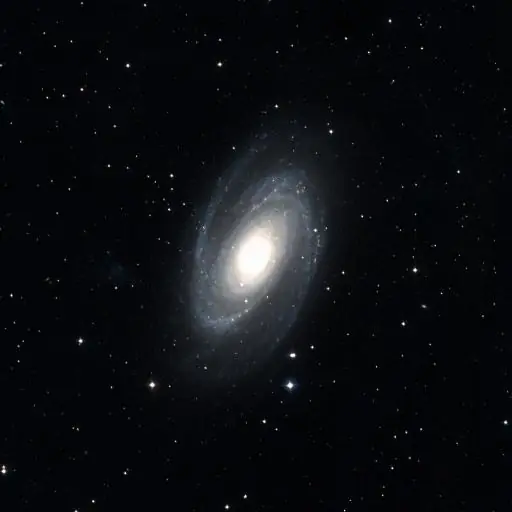
Found on New Year’s Eve 1774 — a grand spiral whose pull set its neighbour M 82 ablaze with new stars.
On the last night of 1774, Johann Elert Bode in Berlin spotted two faint patches of light in Ursa Major. The brighter one now carries his name: Bode’s Galaxy. Pierre Méchain and Charles Messier found it again in 1779, and it entered Messier’s catalogue as M 81.
M 81 is a grand-design spiral galaxy, the largest in a group of galaxies that are among our nearer neighbours. It is not a gentle host. Its gravity has tugged at its companions M 82 and NGC 3077, drawing streamers of hydrogen out of all three galaxies and sending gas tumbling into the hearts of the smaller two, where it lit up bursts of star birth. At M 81’s own centre, a black hole of about 70 million suns feeds a disc of gas and fires a one-sided jet — and it may have a smaller black hole partner circling it every 30 years or so.
Bode's Galaxy (M 81) is 12 million light-years away: the light we see from it set off about 12 million years ago, when great apes were spreading through Africa and Europe.
Did you know?
- A supernova that changed costume. SN 1993J, found by F. García in Spain, began like a normal Type II supernova, rich in hydrogen. Then the hydrogen faded and helium took over. It was classed as Type IIb, a transitional kind, and was the second-brightest Type II of the 20th century.
- Mystery radio flashes. In 2022 astronomers reported that a repeating fast radio burst — a flash of radio waves lasting a few thousandths of a second — may come from M 81.
- Measured by Hubble. The Hubble Space Telescope pinned down M 81’s distance by timing its Cepheid variable stars, using the rule linking their pulse to their brightness discovered by Henrietta Swan Leavitt.
How big is it?
76% of the Milky Way’s width. Light itself takes 76,000 years to cross it. Shrink it to the length of a football pitch and our whole Solar System would be smaller than a bacterium.
A bright grand-design spiral in Ursa Major, visible in binoculars as an oval glow with M82 just over half a degree away — together one of the best galaxy pairs in the sky.
When and where to see it
It is best placed in the evening sky around March, when it crosses the meridian at about 10 pm local time (around midnight in February). It can be seen from everywhere north of 21°S and never sets north of 21°N.
At its highest it stands 71° up from 50°N, 56° up from 35°N, 21° up from the equator, below the horizon from 35°S.
Facts
- Type
- Galaxy
- Constellation
- Ursa Major
- Designations
- M 81, NGC 3031
- Magnitude
- 6.9
- Apparent size
- 22′ × 11′
- Position
- RA 9h 55.6m, Dec +69° 4′ (J2000)
- Distance
- 12 million light-years
- Discovered
- Johann Elert Bode, 1774, Found on 31 December 1774; Méchain and Messier recovered it in 1779
Open AstroPilot to see when Bode's Galaxy (M 81) is highest tonight from your location, how easy it is with your telescope or binoculars, and an eyepiece view.