Lagoon Nebula (M 8)
Lagoon Nebula (M 8) is an emission nebula in the constellation Sagittarius, magnitude 4.6, 1.5° × 40′ across.
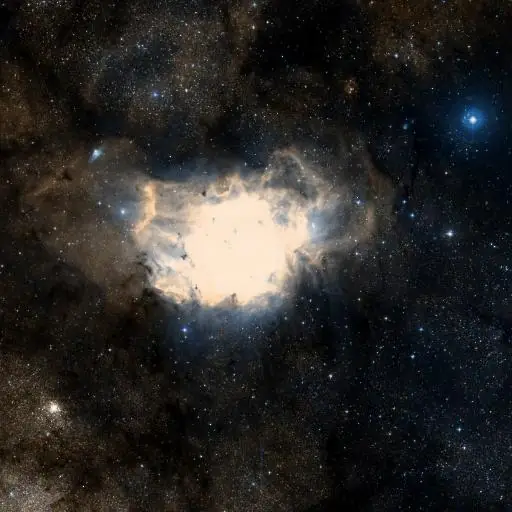
A star factory at work — one of only two you can see with the naked eye from mid-northern latitudes.
Inside the Lagoon, stars are being born right now. In 2006 astronomers found four Herbig–Haro objects in its brightest region, the Hourglass — glowing knots where jets from newborn stars slam into the surrounding gas. They are direct evidence that young stars here are still gathering mass.
The whole cloud is an emission nebula, lit from within by hot young stars. One hot O-type star has carved a funnel-shaped structure into it with its ultraviolet light. Long-exposure photographs show the gas glowing pink, but to the eye it looks grey: our night vision is nearly colour-blind.
Giovanni Hodierna discovered the Lagoon in 1654. John Herschel named the Hourglass, and E. E. Barnard catalogued several dark Bok globules against its glow — dense knots of dust and gas where stars may one day form.
Lagoon Nebula (M 8) is 4,100 light-years away: the light we see from it set off around 2080 BC, 490 years after the Great Pyramid of Giza was completed.
Did you know?
- Only two of its kind. From mid-northern latitudes, just two star-forming nebulae are faintly visible to the naked eye: the Lagoon and the Orion Nebula.
- Not that Hourglass. The Lagoon’s Hourglass, named by John Herschel, is a different object from the Engraved Hourglass Nebula in Musca, a dying star’s shell made famous by Hubble.
How big is it?
25 times the distance from the Sun to the nearest star. Light itself takes 107 years to cross it. Shrink our Solar System — the Sun and all eight planets — to the size of a coin, and the Lagoon Nebula would be 2.71 km across (a 35-minute walk); the nearest star would be a football pitch away, and the Milky Way 2,520 km across.
A bright emission nebula visible to the naked eye from dark sites, crossed by a dark lane (the 'lagoon') with the young cluster NGC 6530 on its eastern side. A UHC filter brings out the gas and the bright Hourglass region near its western end.
When and where to see it
It is best placed in the evening sky around July, when it crosses the meridian at about 10 pm local time (around midnight in June). It can be seen from everywhere south of 66°N and never sets south of 66°S.
At its highest it stands 16° up from 50°N, 31° up from 35°N, 66° up from the equator, 79° up from 35°S.
Facts
- Type
- Emission nebula
- Constellation
- Sagittarius
- Designations
- M 8, NGC 6523, NGC 6533
- Magnitude
- 4.6
- Apparent size
- 1.5° × 40′
- Position
- RA 18h 3.7m, Dec −24° 23′ (J2000)
- Distance
- 4,100 light-years
- Discovered
- Giovanni Hodierna, 1654
Open AstroPilot to see when Lagoon Nebula (M 8) is highest tonight from your location, how easy it is with your telescope or binoculars, and an eyepiece view.