M 77 (NGC 1068)
M 77 (NGC 1068) is a galaxy in the constellation Cetus, magnitude 8.9, 6.1′ × 5.6′ across.
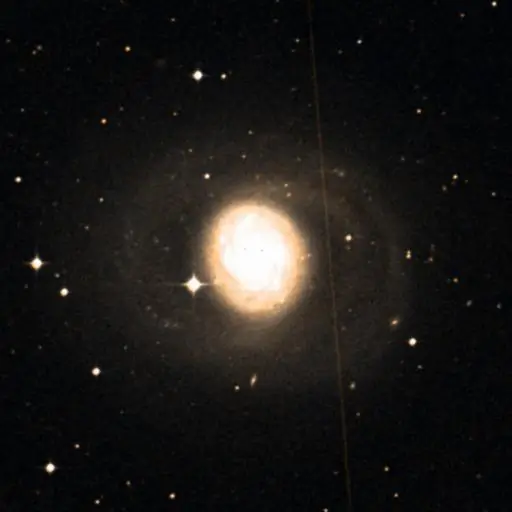
A galaxy with a blazing, dust-hidden heart — and one of the first known sources of cosmic neutrinos.
Nebula or star cluster? Pierre Méchain, who found M 77 in 1780, called it a nebula; Charles Messier and William Herschel both thought it was a cluster of stars. It is neither. M 77 is a spiral galaxy with a fiercely active core, one of the brightest Seyfert galaxies — a class named after Carl Seyfert, who described galaxies with such intense, star-like centres in 1943.
At its heart a supermassive black hole is feeding on gas, but we cannot see it directly: thick dust blocks the view. In 2022 astronomers mapped that hidden dust cloud in infrared light. M 77 is the prototype of its class and a key test of a big idea — that two kinds of active galaxy may be the same thing seen from different angles, with dust hiding the core in one view but not the other.
M 77 (NGC 1068) is 46 million light-years away: the light we see from it set off about 46 million years ago, when mammals were taking over a world without dinosaurs.
Did you know?
- Ghost particles. In November 2022 the IceCube detector, buried in Antarctic ice, traced high-energy neutrinos to M 77’s core. It was only the fourth known source of neutrinos from space, after the Sun, Supernova 1987A and a distant blazar.
- A twisted neighbour. M 77 leads a small group of galaxies. One of them, the edge-on spiral NGC 1055, has probably been twisted out of shape by M 77’s gravity.
- A hidden bar. In visible light M 77 shows no bar, but infrared images reveal a prominent one across its centre.
How big is it?
82% of the Milky Way’s width. Light itself takes 82,000 years to cross it. Shrink it to the length of a football pitch and our whole Solar System would be smaller than a bacterium.
The brightest Seyfert galaxy, with an intensely bright active nucleus; telescopes show a compact oval glow around a star-like core.
When and where to see it
It is best placed in the evening sky around December, when it crosses the meridian at about 10 pm local time (around midnight in November). It sits on the celestial equator, so it can be seen from almost everywhere on Earth.
At its highest it stands 40° up from 50°N, 55° up from 35°N, 90° up from the equator, 55° up from 35°S.
Facts
- Type
- Galaxy
- Constellation
- Cetus
- Designations
- NGC 1068, Cetus A, Squid Galaxy
- Magnitude
- 8.9
- Apparent size
- 6.1′ × 5.6′
- Position
- RA 2h 42.7m, Dec −0° 1′ (J2000)
- Distance
- 46 million light-years
- Discovered
- Pierre Méchain, 1780, Méchain passed it on to Messier
Open AstroPilot to see when M 77 (NGC 1068) is highest tonight from your location, how easy it is with your telescope or binoculars, and an eyepiece view.