Little Dumbbell Nebula (M 76)
Little Dumbbell Nebula (M 76) is a planetary nebula in the constellation Perseus, magnitude 10.1, 2.7′ × 1.8′ across.
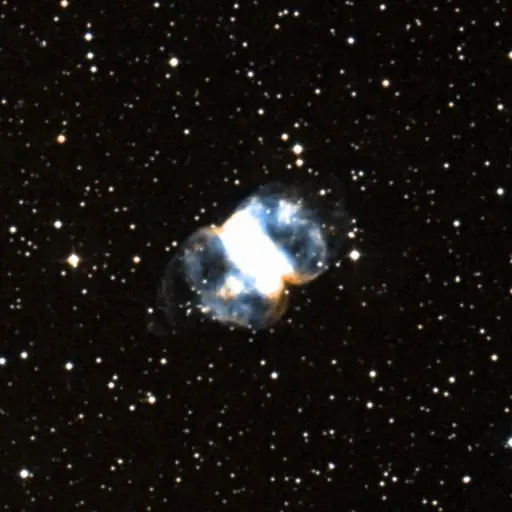
A dying star’s ring, seen edge-on and flanked by two lobes — once thought to be two separate nebulae.
One nebula or two? Pierre Méchain found this little glow in Perseus in 1780, and it became number 76 in Messier’s list. Later observers took it for two separate nebulae, so it carries two numbers in the New General Catalogue: NGC 650 and NGC 651.
Its true nature took time to pin down. William Huggins’s spectrum showed it was glowing gas, and in 1891 Isaac Roberts suggested it might be a ring like M 57, seen from the side. Heber Curtis finally classed it as a planetary nebula in 1918. Roberts was close. As it was dying, the star first threw off a ring, which we see edge-on as the bright central bar. Soon after, it shed the rest of its outer layers in two lobes billowing from the ring’s openings, leaving a white dwarf at the centre.
Little Dumbbell Nebula (M 76) is 3,600 light-years away: the light we see from it set off around 1580 BC, 250 years before Tutankhamun was buried in the Valley of the Kings.
Did you know?
- Named after a big sibling. It is called the Little Dumbbell for its resemblance to the brighter Dumbbell Nebula, M 27, in Vulpecula. Others call it the Barbell or the Cork.
- A white-hot remnant. The white dwarf at its heart has a surface temperature of about 88,000 kelvin — some fifteen times hotter than the surface of the Sun.
How big is it?
2,970 Solar Systems side by side. Light itself takes 2.8 years to cross it. Shrink our Solar System — the Sun and all eight planets — to the size of a coin, and the Little Dumbbell Nebula would be 71.4 m across (about the length of a football pitch); the nearest star would be a football pitch away, and the Milky Way 2,520 km across.
A planetary nebula in Perseus that looks like a tiny version of M27, with two lobes; it is one of the fainter Messier objects, and an OIII filter helps.
When and where to see it
It is best placed in the evening sky around November, when it crosses the meridian at about 10 pm local time (around midnight in October). It can be seen from everywhere north of 38°S and never sets north of 38°N.
At its highest it stands 88° up from 50°N, 73° up from 35°N, 38° up from the equator, 3° up from 35°S.
Facts
- Type
- Planetary nebula
- Constellation
- Perseus
- Designations
- M 76, NGC 650, NGC 651, Barbell Nebula, Cork Nebula
- Magnitude
- 10.1
- Apparent size
- 2.7′ × 1.8′
- Position
- RA 1h 42.3m, Dec +51° 35′ (J2000)
- Distance
- 3,600 light-years
- Discovered
- Pierre Méchain, 1780
Open AstroPilot to see when Little Dumbbell Nebula (M 76) is highest tonight from your location, how easy it is with your telescope or binoculars, and an eyepiece view.