Phantom Galaxy (M 74)
Phantom Galaxy (M 74) is a galaxy in the constellation Pisces, magnitude 9.4, 9.9′ × 9.3′ across.
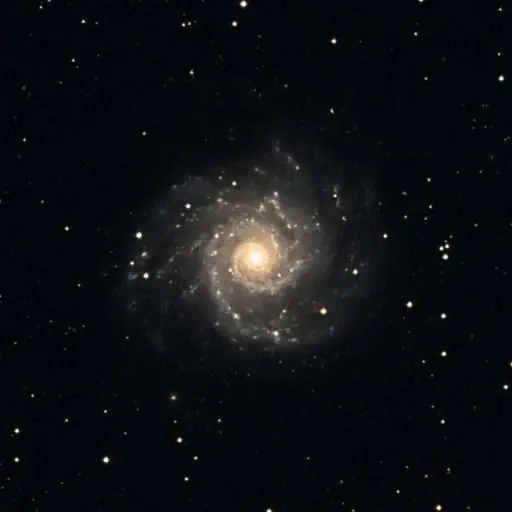
A textbook two-armed spiral, home to a hypernova and a mysterious flickering X-ray source.
Two clean, well-defined arms wind out from the centre of M 74, making it the classic example of a grand-design spiral galaxy, home to around 100 billion stars. Because we see it face-on, professional astronomers use it to study how spiral arms form and keep their shape. Pierre Méchain found it in 1780 and passed the news to Charles Messier, who added it to his list.
In July 2022 it became one of the early targets of the James Webb Space Telescope. Since 2002 three supernovae have been seen in its arms, and in 2019 a flare appeared that may have been a giant star’s violent outburst.
Phantom Galaxy (M 74) is 32 million light-years away: the light we see from it set off about 32 million years ago, when the Himalayas and the Alps were rising.
Did you know?
- A hypernova. In 2002 Yoji Hirose discovered SN 2002ap, a rare Type Ic explosion of the extra-powerful kind called a hypernova. It was the brightest supernova of the year, and it helped test ideas about gamma-ray bursts.
- An echo of light. Ben Sugerman found a light echo from SN 2003gd: the blast’s light bouncing off a sheet of dust in front of it. Such echoes are rare, and they reveal what the dust is made of.
- A middleweight black hole?. In 2005 the Chandra X-ray Observatory found a source in M 74 that flares every two hours or so with more X-ray power than a neutron star can manage. It may be a black hole of around 10,000 suns.
How big is it?
About as wide as our Milky Way. Light itself takes 92,000 years to cross it. Shrink it to the length of a football pitch and our whole Solar System would be smaller than a bacterium. It holds about 100 billion stars — the Milky Way has a few hundred billion.
A grand-design spiral seen face-on, beautiful in photographs but one of the hardest Messier objects to see: its light is spread thin, so it needs dark skies and low power.
When and where to see it
It is best placed in the evening sky around November, when it crosses the meridian at about 10 pm local time (around midnight in October). It can be seen from everywhere north of 74°S and never sets north of 74°N.
At its highest it stands 56° up from 50°N, 71° up from 35°N, 74° up from the equator, 39° up from 35°S.
Facts
- Type
- Galaxy
- Constellation
- Pisces
- Designations
- M 74, NGC 628
- Magnitude
- 9.4
- Apparent size
- 9.9′ × 9.3′
- Position
- RA 1h 36.7m, Dec +15° 47′ (J2000)
- Distance
- 32 million light-years
- Discovered
- Pierre Méchain, 1780, Méchain passed it on to Messier
Open AstroPilot to see when Phantom Galaxy (M 74) is highest tonight from your location, how easy it is with your telescope or binoculars, and an eyepiece view.