M 73 (NGC 6994)
M 73 (NGC 6994) is an asterism in the constellation Aquarius, magnitude 9.0, 2.8′ across.
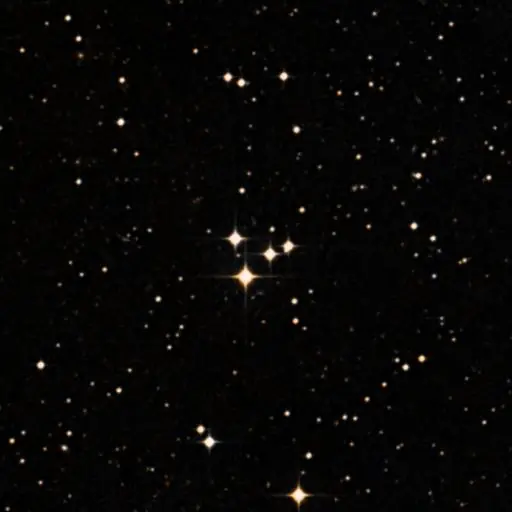
Four stars, one long argument: a real cluster or a coincidence? It took until 2002 to settle.
In 1780 Charles Messier recorded four faint stars in Aquarius, wrapped, he thought, in a little nebulosity. John Herschel later looked and saw no nebula at all, and doubted that it was a true cluster. Even so, M 73 kept its place in the great catalogues, including the New General Catalogue.
The argument flared up again in 2000. One team studied the stars’ colours and brightness and declared M 73 an old open cluster; another, using similar methods, called it a chance alignment. A third argued that four such stars lining up by accident was very unlikely. In 2002 M. Odenkirchen and C. Soubiran settled it with detailed spectra: the stars lie at very different distances and move in different directions. M 73 is an asterism.
M 73 (NGC 6994) is 1,700 light-years away: the light we see from it set off around AD 330, 200 years after the Pantheon was rebuilt in Rome.
Did you know?
- Why it still matters. Studying chance groupings like M 73 helps astronomers recognise real, sparse clusters — the last remnants of open clusters being pulled apart by the Milky Way.
- Far apart in depth. Gaia measurements show the farthest of the four stars is more than twice as far from us as the nearest. One of them is itself a binary star.
Four stars in Aquarius forming a small Y. Messier logged it as a cluster with nebulosity, but the stars are unrelated and lie at different distances.
When and where to see it
It is best placed in the evening sky around September, when it crosses the meridian at about 10 pm local time (around midnight in August). It can be seen from everywhere south of 77°N and never sets south of 77°S.
At its highest it stands 27° up from 50°N, 42° up from 35°N, 77° up from the equator, 68° up from 35°S.
Facts
- Type
- Asterism
- Constellation
- Aquarius
- Designations
- NGC 6994
- Magnitude
- 9.0
- Apparent size
- 2.8′
- Position
- RA 20h 58.9m, Dec −12° 38′ (J2000)
- Distance
- 1,700 light-years
- Discovered
- Charles Messier, 1780
Open AstroPilot to see when M 73 (NGC 6994) is highest tonight from your location, how easy it is with your telescope or binoculars, and an eyepiece view.