M 67 (NGC 2682)
M 67 (NGC 2682) is an open cluster in the constellation Cancer, magnitude 6.1, 30′ across.
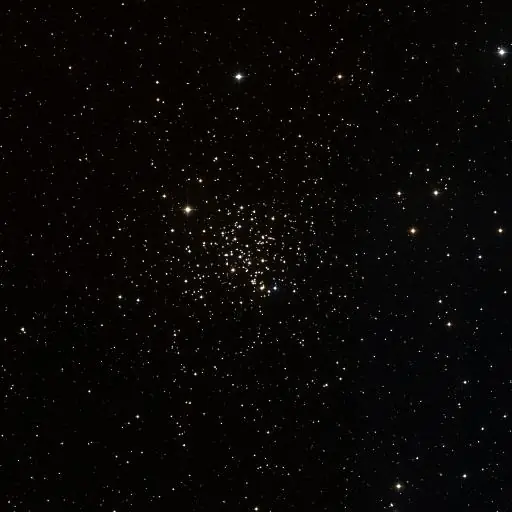
A cluster nearly as old as the Sun, full of Sun-like stars — once suspected of being our birthplace.
Most open clusters scatter long before they reach a billion years. M 67 has held together for around four billion years, nearly as long as the Sun has existed. That makes it a rare survivor, and a gift to science: well over 500 stars of the same age and distance, more than 100 of them much like our Sun, with almost no dust in the way. It has become a classic laboratory for testing how stars live and age.
With so many Sun-like stars of about the right age, some astronomers wondered whether our Sun was born here and later thrown out. Computer simulations are doubtful: the outer Solar System might not have survived the ejection, and M 67 itself probably wouldn’t have either. Johann Gottfried Koehler found this open cluster in 1779.
M 67 (NGC 2682) is 2,700 light-years away: the light we see from it set off around 680 BC, around the time the first recorded Olympic Games were held.
Did you know?
- Spinning like the Sun. In 2016 astronomers used the Kepler space telescope to time starspots on 20 of M 67’s Sun-like stars. They rotate in about 26 days — just like the Sun — a sign that our star is typical for its size and age.
- Planets in the family. A search for wobbling stars has turned up planets around five of M 67’s members.
- A shrinking cluster. M 67 may once have been about ten times heavier. Over billions of years, close encounters have flung many of its lighter stars away, leaving a cluster weighted towards heavier ones.
How big is it?
Born about 4.3 billion years ago, when there were no animals on Earth at all. Light itself takes 24 years to cross it. Gaia has picked out 1,844 stars moving together through space as its members. That’s 5.6 times the distance from the Sun to the nearest star. Shrink our Solar System — the Sun and all eight planets — to the size of a coin, and M 67 would be 595 m across (6 football pitches end to end); the nearest star would be a football pitch away, and the Milky Way 2,520 km across.
One of the oldest known open clusters, about 4 billion years old: a rich field of faint stars, easy in binoculars near Acubens (Alpha Cancri).
When and where to see it
It is best placed in the evening sky around March, when it crosses the meridian at about 10 pm local time (around midnight in January). It can be seen from everywhere north of 78°S and never sets north of 78°N.
At its highest it stands 52° up from 50°N, 67° up from 35°N, 78° up from the equator, 43° up from 35°S.
Facts
- Type
- Open cluster
- Constellation
- Cancer
- Designations
- NGC 2682, Mel 94, Cr 204, King Cobra Cluster, Golden Eye Cluster, Melotte 94, Collinder 204
- Magnitude
- 6.1
- Apparent size
- 30′
- Position
- RA 8h 51.3m, Dec +11° 49′ (J2000)
- Distance
- 2,700 light-years
- Discovered
- Johann Gottfried Koehler, 1779
Open AstroPilot to see when M 67 (NGC 2682) is highest tonight from your location, how easy it is with your telescope or binoculars, and an eyepiece view.