M 66 (NGC 3627)
M 66 (NGC 3627) is a galaxy in the constellation Leo, magnitude 8.9, 10′ × 4.6′ across.
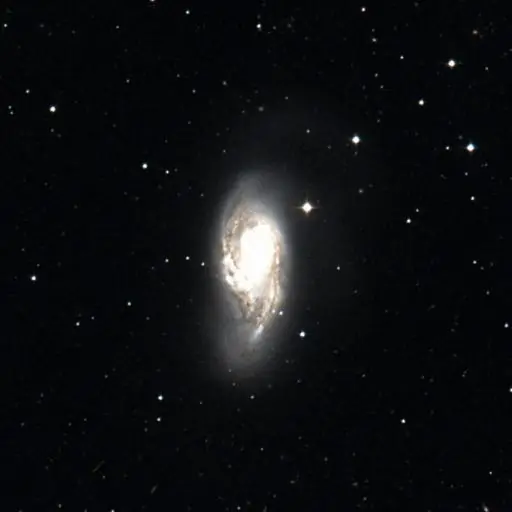
The brightest of the Leo Triplet, its arms pulled out of shape by a close brush with a neighbour.
On 1 March 1780 Charles Messier noted a nebula in Leo that he described as “very long and very faint”. He was looking at the brightest of the three galaxies now called the Leo Triplet, a small, close-knit group.
M 66 carries the scars of a past encounter with its neighbour NGC 3628. The pull of that passage piled up mass in its centre and packed much of its gas into dense molecular clouds. The result is a spiral galaxy with oddly shaped arms and dust lanes — strange enough to be noted in Halton Arp’s Atlas of Peculiar Galaxies. Bright star clusters line its arms, where young stars light up the surrounding gas.
M 66 (NGC 3627) is 33 million light-years away: the light we see from it set off about 33 million years ago, when the Himalayas and the Alps were rising.
Did you know?
- A stolen clump. Radio maps show a clump of hydrogen that no longer turns with the rest of the galaxy — gas apparently pulled out of one of its spiral arms during the encounter.
- Five explosions. Five supernovae have been reported in M 66 since 1973. One, in 1997, may not have been a true supernova at all, but a giant star’s outburst or two stars merging.
How big is it?
About as wide as our Milky Way. Light itself takes 99,000 years to cross it. Shrink it to the length of a football pitch and our whole Solar System would be smaller than a bacterium.
The brightest member of the Leo Triplet, a spiral distorted by its neighbors; it looks broader and more mottled than M65 beside it.
When and where to see it
It is best placed in the evening sky around April, when it crosses the meridian at about 10 pm local time (around midnight in March). It can be seen from everywhere north of 77°S and never sets north of 77°N.
At its highest it stands 53° up from 50°N, 68° up from 35°N, 77° up from the equator, 42° up from 35°S.
Facts
- Type
- Galaxy
- Constellation
- Leo
- Designations
- NGC 3627, Leo Triplet
- Magnitude
- 8.9
- Apparent size
- 10′ × 4.6′
- Position
- RA 11h 20.3m, Dec +12° 60′ (J2000)
- Distance
- 33 million light-years
- Discovered
- Charles Messier, 1780
Open AstroPilot to see when M 66 (NGC 3627) is highest tonight from your location, how easy it is with your telescope or binoculars, and an eyepiece view.