M 65 (NGC 3623)
M 65 (NGC 3623) is a galaxy in the constellation Leo, magnitude 9.3, 7.6′ × 2.0′ across.
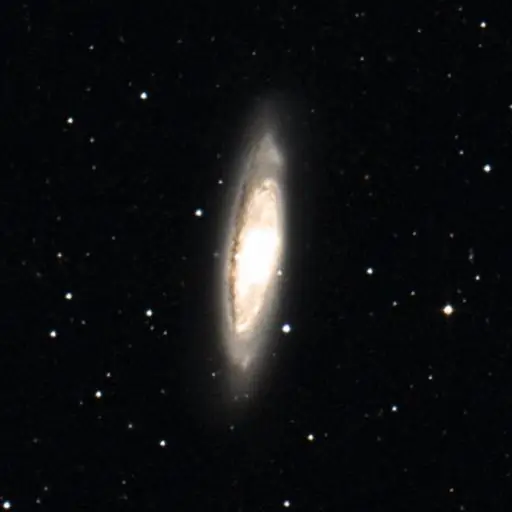
The quiet one of the Leo Triplet — and the subject of a discovery mix-up that spread from book to book.
Who found M 65? Charles Messier did, in 1780. But in the 19th century William Henry Smyth wrote in his popular guide, A Cycle of Celestial Objects, that Pierre Méchain had pointed it out to Messier. Kenneth Glyn Jones repeated the slip in Messier’s Nebulae and Star Clusters, and from there it spread into many other books.
Of the three galaxies in the Leo Triplet, M 65 is the calm one. This spiral galaxy has little gas or dust left, so it makes few new stars, and old stars far outnumber young ones. Yet it hasn’t entirely escaped its neighbours. Its disc looks slightly warped, and a fairly recent burst of star birth in its arms hints at a gentle disturbance — perhaps a weak brush with the other two, which seem to have interacted strongly about 800 million years ago.
M 65 (NGC 3623) is 40 million light-years away: the light we see from it set off about 40 million years ago, when mammals were taking over a world without dinosaurs.
Did you know?
- A mystery signal. Radio surveys show a source about two arcminutes from M 65’s core. Nobody has identified it, and no published paper has studied it.
- A bar in disguise?. M 65 may have a central bar — often a sign of tidal disturbance — but because we see the galaxy steeply tilted, it is hard to be sure.
- One explosion so far. Only one supernova has been seen in M 65: SN 2013am, found by Matsuo Sugano in March 2013.
How big is it?
About as wide as our Milky Way. Light itself takes 89,000 years to cross it. Shrink it to the length of a football pitch and our whole Solar System would be smaller than a bacterium.
A bright, tilted spiral in the Leo Triplet, sharing a low-power field with M66 and NGC 3628.
When and where to see it
It is best placed in the evening sky around April, when it crosses the meridian at about 10 pm local time (around midnight in March). It can be seen from everywhere north of 77°S and never sets north of 77°N.
At its highest it stands 53° up from 50°N, 68° up from 35°N, 77° up from the equator, 42° up from 35°S.
Facts
- Type
- Galaxy
- Constellation
- Leo
- Designations
- NGC 3623, Leo Triplet
- Magnitude
- 9.3
- Apparent size
- 7.6′ × 2.0′
- Position
- RA 11h 18.9m, Dec +13° 6′ (J2000)
- Distance
- 40 million light-years
- Discovered
- Charles Messier, 1780
Open AstroPilot to see when M 65 (NGC 3623) is highest tonight from your location, how easy it is with your telescope or binoculars, and an eyepiece view.