Black Eye Galaxy (M 64)
Black Eye Galaxy (M 64) is a galaxy in the constellation Coma Berenices, magnitude 8.5, 11′ × 5.3′ across.
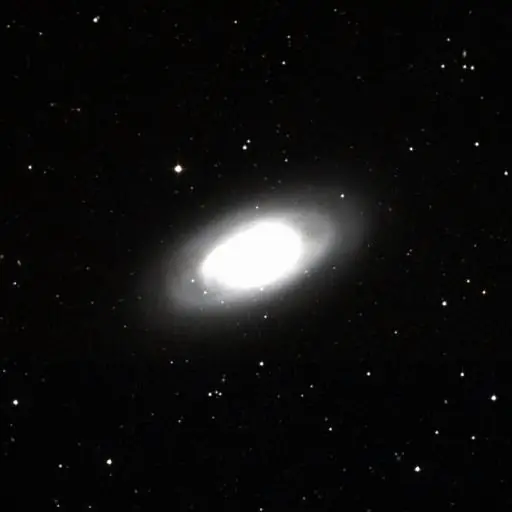
A galaxy with a bruised eye — and gas that spins in two directions at once.
In March 1779 the English astronomer Edward Pigott came across this galaxy in Coma Berenices. Johann Bode found it a month later, and Charles Messier the following year. The dark band of dust across its bright centre earned it its names: the Black Eye, the Evil Eye or, more kindly, the Sleeping Beauty.
Its real oddity cannot be seen in a telescope. M 64’s gas forms two discs of roughly equal mass that rotate in opposite directions — the inner one, home of the dark dust, turning against the outer one. Yet its roughly 100 billion stars all turn the same way. Perhaps M 64 swallowed a gas-rich companion galaxy that was orbiting backwards, or it has slowly gathered gas clouds from intergalactic space. Either way, the inner disc is busily forming new stars.
Black Eye Galaxy (M 64) is 15 million light-years away: the light we see from it set off about 15 million years ago, when great apes were spreading through Africa and Europe.
Did you know?
- A modest black hole. The black hole at M 64’s centre weighs about 8.4 million suns — roughly twice the one at the heart of our Milky Way.
- A loner. M 64 lives a fairly isolated life, with no big galaxy nearby to blame for its strange two-way spin.
How big is it?
46% of the Milky Way’s width. Light itself takes 46,000 years to cross it. Shrink it to the length of a football pitch and our whole Solar System would be about the size of a red blood cell. It holds about 100 billion stars — the Milky Way has a few hundred billion.
A bright spiral with a dark band of dust across one side of its nucleus — the 'black eye' — which medium telescopes can show.
When and where to see it
It is best placed in the evening sky around May, when it crosses the meridian at about 10 pm local time (around midnight in April). It can be seen from everywhere north of 68°S and never sets north of 68°N.
At its highest it stands 62° up from 50°N, 77° up from 35°N, 68° up from the equator, 33° up from 35°S.
Facts
- Type
- Galaxy
- Constellation
- Coma Berenices
- Designations
- M 64, NGC 4826, Evil Eye Galaxy
- Magnitude
- 8.5
- Apparent size
- 11′ × 5.3′
- Position
- RA 12h 56.7m, Dec +21° 41′ (J2000)
- Distance
- 15 million light-years
- Discovered
- Edward Pigott, 1779, Bode found it a month later, Messier in 1780
Open AstroPilot to see when Black Eye Galaxy (M 64) is highest tonight from your location, how easy it is with your telescope or binoculars, and an eyepiece view.