Sunflower Galaxy (M 63)
Sunflower Galaxy (M 63) is a galaxy in the constellation Canes Venatici, magnitude 8.6, 12′ × 7.2′ across.
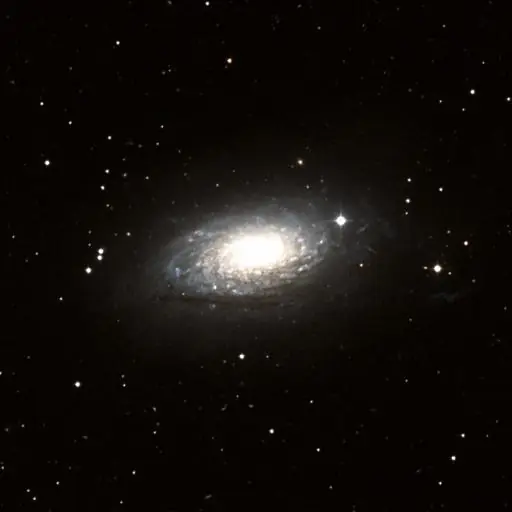
A galaxy of woolly, patchy arms — hiding a neat two-armed spiral that only infrared light reveals.
Pierre Méchain, Charles Messier’s colleague and fellow comet hunter, found this galaxy first; Messier confirmed it on 14 June 1779. In the mid-1800s Lord Rosse’s great telescope picked out spiral structure in it, making it one of the first galaxies in which arms were ever seen.
In ordinary light M 63 has no long, sweeping arms — just a mass of short, broken fragments. Astronomers call it a flocculent, or “woolly”, spiral galaxy. Infrared light tells a different story: beneath the patchwork lie two smooth, symmetrical arms. Farther out, radio telescopes trace a vast disc of hydrogen gas reaching well beyond the visible galaxy, warped like the brim of a hat.
Sunflower Galaxy (M 63) is 32 million light-years away: the light we see from it set off about 32 million years ago, when the Himalayas and the Alps were rising.
Did you know?
- An off-centre halo. The warp in M 63’s gas disc suggests its dark matter halo is offset from the inner galaxy. The cause is unclear, but the warp points towards a small companion galaxy, UGC 8313.
- The Whirlpool’s neighbour. M 63 belongs to the same small group of galaxies as M 51, the Whirlpool.
- A supernova found twice. In May 1971 a supernova here was spotted by Glenn Jolly and, five days later, independently by Roger Clark. Its spectrum behaved oddly for its type.
How big is it?
About as wide as our Milky Way. Light itself takes 110,000 years to cross it. Shrink it to the length of a football pitch and our whole Solar System would be smaller than a bacterium. It holds about 400 billion stars — the Milky Way has a few hundred billion.
A bright spiral whose short, patchy arms give it the look of a sunflower in photographs; telescopes show an oval glow with a bright, star-like nucleus.
When and where to see it
It is best placed in the evening sky around May, when it crosses the meridian at about 10 pm local time (around midnight in April). It can be seen from everywhere north of 48°S and never sets north of 48°N.
At its highest it stands 82° up from 50°N, 83° up from 35°N, 48° up from the equator, 13° up from 35°S.
Facts
- Type
- Galaxy
- Constellation
- Canes Venatici
- Designations
- M 63, NGC 5055
- Magnitude
- 8.6
- Apparent size
- 12′ × 7.2′
- Position
- RA 13h 15.8m, Dec +42° 2′ (J2000)
- Distance
- 32 million light-years
- Discovered
- Pierre Méchain, 1779, Confirmed by Messier on 14 June 1779
Open AstroPilot to see when Sunflower Galaxy (M 63) is highest tonight from your location, how easy it is with your telescope or binoculars, and an eyepiece view.