M 61 (NGC 4303)
M 61 (NGC 4303) is a galaxy in the constellation Virgo, magnitude 9.7, 6.9′ × 6.6′ across.
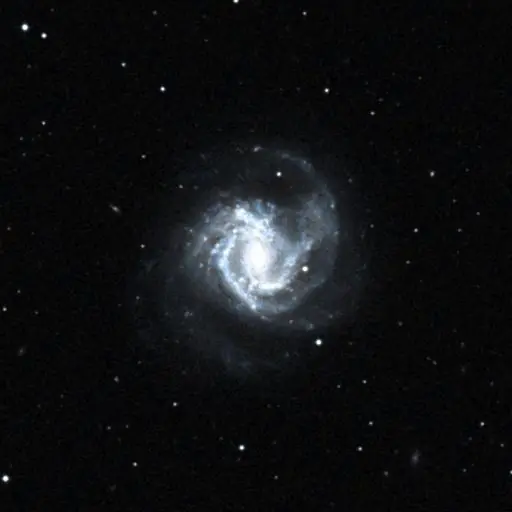
Eight exploding stars in under a century — one of the busiest supernova factories known.
On 5 May 1779 Barnaba Oriani, in Milan, spotted a faint glow in Virgo. Charles Messier saw it the same night but mistook it for a comet; it was six days before he realised it was a nebula. Oriani gets the credit.
M 61 is a lively spiral galaxy with a faint bar. Its centre is a starburst: a cluster of about a million suns that formed only four million years ago, beside a candidate black hole of around five million suns. Unlike most spirals in the Virgo Cluster, which are short of gas, it still holds an unusual amount of cool hydrogen — fuel for the new stars and bright glowing clouds scattered across its disc.
M 61 (NGC 4303) is 50 million light-years away: the light we see from it set off about 50 million years ago, when mammals were taking over a world without dinosaurs.
Did you know?
- Supernova factory. Eight supernovae have been seen in M 61 since 1926, making it one of the most prolific galaxies known for them. Three were found by the Japanese astronomer Kōichi Itagaki, in 2006, 2008 and 2014.
- A fresh discovery. In 2026 the Vera C. Rubin Observatory revealed a faint stream of stars to the north of M 61 — the remains, perhaps, of a smaller system being pulled apart.
How big is it?
About as wide as our Milky Way. Light itself takes 100,000 years to cross it. Shrink it to the length of a football pitch and our whole Solar System would be smaller than a bacterium.
One of the largest spirals in the Virgo Cluster, seen face-on; large telescopes show hints of arms around its bright core. Several supernovae have been seen in it.
When and where to see it
It is best placed in the evening sky around April, when it crosses the meridian at about 10 pm local time (around midnight in March). It can be seen from everywhere north of 86°S and never sets north of 86°N.
At its highest it stands 44° up from 50°N, 59° up from 35°N, 86° up from the equator, 51° up from 35°S.
Facts
- Type
- Galaxy
- Constellation
- Virgo
- Designations
- NGC 4303, Swelling Spiral Galaxy
- Magnitude
- 9.7
- Apparent size
- 6.9′ × 6.6′
- Position
- RA 12h 21.9m, Dec +4° 28′ (J2000)
- Distance
- 50 million light-years
- Discovered
- Barnaba Oriani, 1779, Messier saw it the same night but took it for a comet
Open AstroPilot to see when M 61 (NGC 4303) is highest tonight from your location, how easy it is with your telescope or binoculars, and an eyepiece view.