M 60 (NGC 4649)
M 60 (NGC 4649) is a galaxy in the constellation Virgo, magnitude 8.8, 6.8′ × 5.5′ across.
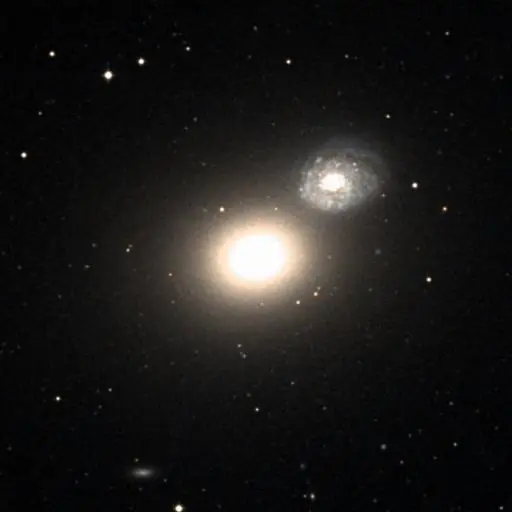
Home to one of the biggest black holes known — and the fastest galaxy in Hubble’s famous 1929 paper.
In 1929 Edwin Hubble published the graph that pointed to an expanding universe: the farther away a galaxy is, the faster it recedes. The fastest-moving galaxy in his sample was M 60, racing away at about 1,090 km per second — within 2% of the modern figure. His distances, though, were about eight times too small, so his rate of cosmic expansion came out roughly seven times too high.
M 60 is a giant elliptical galaxy holding about a trillion suns’ worth of mass, nearly half of it dark matter. At its centre lies a black hole of some 4.5 billion suns, one of the largest ever found. It is quiet now, but X-ray images show a cavity carved by jets it fired in more active times. Johann Gottfried Koehler spotted the galaxy in April 1779 while watching a comet.
M 60 (NGC 4649) is 56 million light-years away: the light we see from it set off about 56 million years ago, when mammals were taking over a world without dinosaurs.
Did you know?
- A spiral photobomber. The spiral NGC 4647 overlaps M 60’s edge; together they are listed as Arp 116. They are probably at different distances, but Hubble images hint that a gentle tidal tug may have just begun.
- Losing its gas. As M 60 moves through the Virgo Cluster, the headwind of hot gas is stripping material from its outer halo.
- Leader of a small gang. M 60 dominates a little group of four galaxies, the M 60 group — the closest isolated compact group of galaxies known.
How big is it?
About as wide as our Milky Way. Light itself takes 110,000 years to cross it. Shrink it to the length of a football pitch and our whole Solar System would be smaller than a bacterium.
A giant elliptical galaxy in the Virgo Cluster; the small spiral NGC 4647 appears to touch its edge.
When and where to see it
It is best placed in the evening sky around May, when it crosses the meridian at about 10 pm local time (around midnight in April). It can be seen from everywhere north of 78°S and never sets north of 78°N.
At its highest it stands 52° up from 50°N, 67° up from 35°N, 78° up from the equator, 43° up from 35°S.
Facts
- Type
- Galaxy
- Constellation
- Virgo
- Designations
- NGC 4649
- Magnitude
- 8.8
- Apparent size
- 6.8′ × 5.5′
- Position
- RA 12h 43.7m, Dec +11° 33′ (J2000)
- Distance
- 56 million light-years
- Discovered
- Johann Gottfried Koehler, 1779, Found while following a comet; Messier logged it days later
Open AstroPilot to see when M 60 (NGC 4649) is highest tonight from your location, how easy it is with your telescope or binoculars, and an eyepiece view.