Butterfly Cluster (M 6)
Butterfly Cluster (M 6) is an open cluster in the constellation Scorpius, magnitude 4.2, 25′ across.
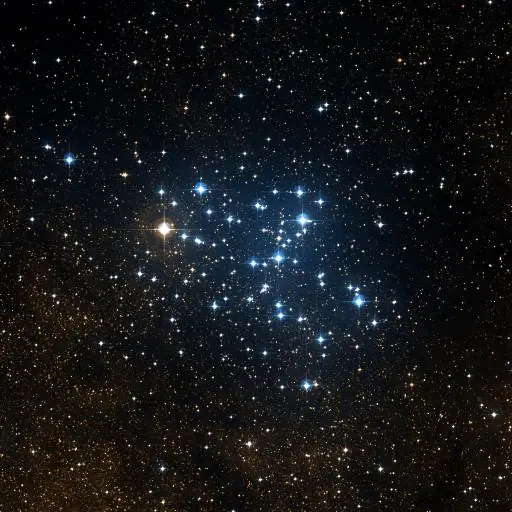
Young blue stars in the shape of a butterfly — perhaps first glimpsed by Ptolemy.
When the stars of the Butterfly Cluster were born, about 94 million years ago, dinosaurs still walked the Earth. By cosmic standards it is young: most of its bright stars are hot, blue B-type stars, and about 120 stars are thought to belong to this open cluster.
Giovanni Battista Hodierna recorded it in 1654, though credit often goes to Jean-Philippe Loys de Chéseaux, who saw it in 1746. Robert Burnham Jr. suggested that Ptolemy may have seen it with the naked eye in the 2nd century while observing its neighbour, M 7. Charles Messier added it to his catalogue on 23 May 1764.
Butterfly Cluster (M 6) is 1,500 light-years away: the light we see from it set off around AD 530, around the time the Hagia Sophia was completed in Constantinople.
Did you know?
- A restless giant. BM Scorpii, the orange giant among the Butterfly’s blue stars, is a semiregular variable: its brightness slowly drifts between magnitude 5.5 and 7.
- Bobbing through the galaxy. The Butterfly follows a nearly circular orbit around the Milky Way, taking about 204 million years per lap and crossing the galaxy’s midplane roughly every 29 million years.
How big is it?
Born about 35 million years ago, when the Himalayas and the Alps were rising. Light itself takes 11 years to cross it. Gaia has picked out 974 stars moving together through space as its members. That’s 2.6 times the distance from the Sun to the nearest star. Shrink our Solar System — the Sun and all eight planets — to the size of a coin, and the Butterfly Cluster would be 275 m across (3 football pitches end to end); the nearest star would be a football pitch away, and the Milky Way 2,520 km across.
A bright open cluster whose stars outline a butterfly with open wings. Its brightest member, the orange giant BM Scorpii, stands out among the blue-white stars; best in binoculars or at low power.
When and where to see it
It is best placed in the evening sky around July, when it crosses the meridian at about 10 pm local time (around midnight in June). It can be seen from everywhere south of 58°N and never sets south of 58°S.
At its highest it stands 8° up from 50°N, 23° up from 35°N, 58° up from the equator, 87° up from 35°S.
Facts
- Type
- Open cluster
- Constellation
- Scorpius
- Designations
- M 6, NGC 6405, Mel 178, Cr 341, Melotte 178, Collinder 341
- Magnitude
- 4.2
- Apparent size
- 25′
- Position
- RA 17h 40.3m, Dec −32° 15′ (J2000)
- Distance
- 1,500 light-years
- Discovered
- Giovanni Battista Hodierna, 1654, Credit often given to de Chéseaux, 1746
Open AstroPilot to see when Butterfly Cluster (M 6) is highest tonight from your location, how easy it is with your telescope or binoculars, and an eyepiece view.