M 59 (NGC 4621)
M 59 (NGC 4621) is a galaxy in the constellation Virgo, magnitude 9.6, 4.5′ × 3.2′ across.
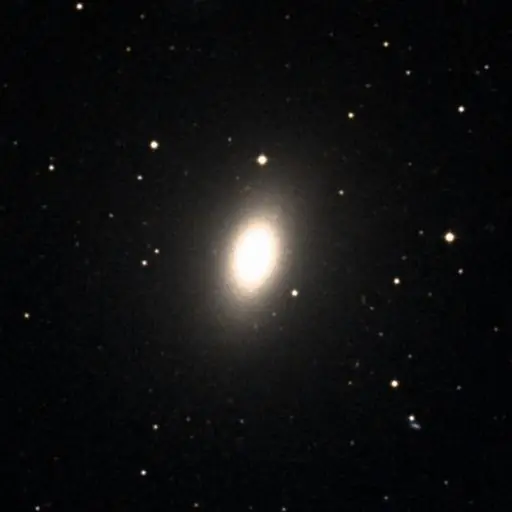
A galaxy whose heart spins the wrong way — a clue to some ancient collision.
In April 1779 the German astronomer Johann Gottfried Koehler was following a comet through Virgo when he noticed two faint glows close together. Charles Messier logged both about three days later, as M 59 and M 60. Each turned out to be an elliptical galaxy in the vast Virgo Cluster.
M 59 looks like a smooth, flattened oval, but it hides layers. Beneath the main body lies a flatter disc of stars, and the whole thing is wrapped in a round halo. At the very centre is a black hole of around 270 million suns, inside a core that rotates the opposite way to the rest of the galaxy. That core also holds a disc of younger, bluer stars — perhaps the scar of a merger with another galaxy that set off a burst of star birth.
M 59 (NGC 4621) is 49 million light-years away: the light we see from it set off about 49 million years ago, when mammals were taking over a world without dinosaurs.
Did you know?
- Thousands of globulars. About 2,200 globular clusters swarm around M 59 — roughly ten times as many as orbit the Milky Way.
- An in-between galaxy. One of M 59’s two small satellites, M59cO, is a rare in-between: midway between compact ellipticals like M 32 and the even tinier ultra-compact dwarf galaxies.
- Zwicky’s supernova. In May 1939 Fritz Zwicky, who helped coin the word “supernova”, found one here. The area shows no sign of young stars, a clue that it was a Type Ia: an exploding white dwarf.
How big is it?
65% of the Milky Way’s width. Light itself takes 65,000 years to cross it. Shrink it to the length of a football pitch and our whole Solar System would be smaller than a bacterium.
An elliptical galaxy in the Virgo Cluster, sharing a medium-power field with M60.
When and where to see it
It is best placed in the evening sky around May, when it crosses the meridian at about 10 pm local time (around midnight in April). It can be seen from everywhere north of 78°S and never sets north of 78°N.
At its highest it stands 52° up from 50°N, 67° up from 35°N, 78° up from the equator, 43° up from 35°S.
Facts
- Type
- Galaxy
- Constellation
- Virgo
- Designations
- NGC 4621
- Magnitude
- 9.6
- Apparent size
- 4.5′ × 3.2′
- Position
- RA 12h 42.0m, Dec +11° 39′ (J2000)
- Distance
- 49 million light-years
- Discovered
- Johann Gottfried Koehler, 1779, Found while following a comet; Messier logged it days later
Open AstroPilot to see when M 59 (NGC 4621) is highest tonight from your location, how easy it is with your telescope or binoculars, and an eyepiece view.