M 58 (NGC 4579)
M 58 (NGC 4579) is a galaxy in the constellation Virgo, magnitude 9.7, 5.0′ × 3.8′ across.
For a century, perhaps the most distant thing anyone had ever seen — though no one knew it.
On 15 April 1779 Charles Messier was charting a comet’s path through Virgo when he noted a very faint nebula — so faint, he wrote, that it vanished in the slightest light he used to see the wires of his micrometer. Without knowing it, he had recorded what was arguably the most distant object then known — a title it kept until the 1880s.
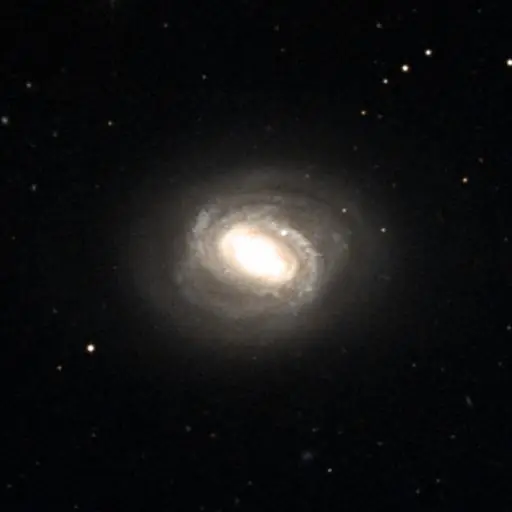
M 58 is a barred spiral galaxy in the Virgo Cluster, and it is running low on fuel. Like several spirals in that crowded cluster it is “anaemic”: interactions with the hot gas that fills the cluster have left it short of the cool hydrogen it needs to make new stars. At its heart sits a black hole of around 70 million suns.
M 58 (NGC 4579) is 55 million light-years away: the light we see from it set off about 55 million years ago, when mammals were taking over a world without dinosaurs.
Did you know?
- The ring bearer. M 58 is one of very few galaxies known to have an ultra-compact nuclear ring — a tiny circle of star-forming regions around its centre. The YouTube series Deep Sky Videos nicknamed it the “ring bearer galaxy”.
- One of only four. Of all the galaxies in Messier’s catalogue, only four are barred spirals — galaxies with a straight bar of stars across their centre. M 58 is one of them.
- A comet hunter’s supernova. Two stars have exploded in M 58. The first, SN 1988A, was co-discovered by Kaoru Ikeya, the Japanese comet hunter whose name is on the great sungrazing Comet Ikeya–Seki.
How big is it?
80% of the Milky Way’s width. Light itself takes 80,000 years to cross it. Shrink it to the length of a football pitch and our whole Solar System would be smaller than a bacterium.
One of the brightest barred spirals of the Virgo Cluster, showing an oval glow with a brighter center.
When and where to see it
It is best placed in the evening sky around May, when it crosses the meridian at about 10 pm local time (around midnight in March). It can be seen from everywhere north of 78°S and never sets north of 78°N.
At its highest it stands 52° up from 50°N, 67° up from 35°N, 78° up from the equator, 43° up from 35°S.
Facts
- Type
- Galaxy
- Constellation
- Virgo
- Designations
- NGC 4579
- Magnitude
- 9.7
- Apparent size
- 5.0′ × 3.8′
- Position
- RA 12h 37.7m, Dec +11° 49′ (J2000)
- Distance
- 55 million light-years
- Discovered
- Charles Messier, 1779
Open AstroPilot to see when M 58 (NGC 4579) is highest tonight from your location, how easy it is with your telescope or binoculars, and an eyepiece view.