Ring Nebula (M 57)
Ring Nebula (M 57) is a planetary nebula in the constellation Lyra, magnitude 8.8, 1.4′ × 1.0′ across.
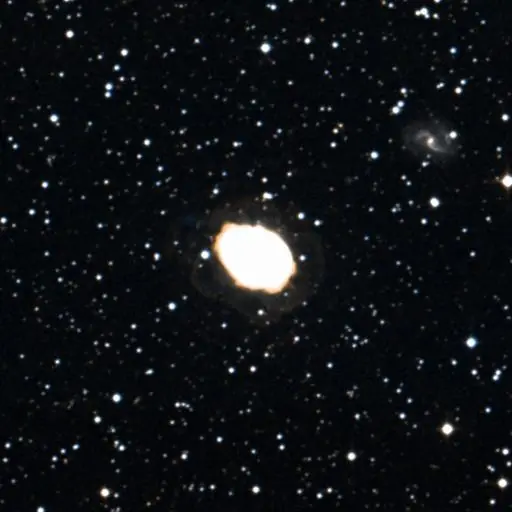
A dying star’s last breath, blown into a glowing ring — a glimpse of what may one day become of our Sun.
Picture a star at the very end of its life, shrugging its outer layers off into space. That is the Ring Nebula, one of the best-known planetary nebulae in the sky. The cast-off gas has been expanding for about 1,600 years, lit up by the bare core left behind — a star that no longer burns any fuel and is slowly cooling into a white dwarf.
Charles Messier found it in January 1779 while hunting comets. Weeks later Antoine Darquier came across it too and wrote that it was “as large as Jupiter” and looked like “a planet which is fading” — a description that may have helped give planetary nebulae their misleading name. Messier and William Herschel suspected it was a knot of faint stars. In 1864 William Huggins split its light into a spectrum and saw the bright lines of glowing gas: proof that some nebulae are not stars at all.
Ring Nebula (M 57) is 2,600 light-years away: the light we see from it set off around 580 BC, 135 years before the Parthenon was dedicated in Athens.
Did you know?
- Painted by atoms. The blue-green glow inside the ring comes from oxygen atoms that have lost two electrons; the reddish rim, from hydrogen and nitrogen. That oxygen light only forms in extremely thin gas, with at most a few thousand atoms per cubic centimetre.
- Not really a ring. The nebula is probably a rugby-ball-shaped shell, thickest around its middle, which we happen to see nearly end-on.
- A tiny, fierce core. The central star has a surface temperature of about 125,000 kelvin — over twenty times hotter than the Sun’s — and shines some 300 times brighter. In 2025 the James Webb Space Telescope found a disc of dust around it.
How big is it?
1,110 Solar Systems side by side. Light itself takes about a year to cross it. Shrink our Solar System — the Sun and all eight planets — to the size of a coin, and the Ring Nebula would be 26.7 m across (about the length of a tennis court); the nearest star would be a football pitch away, and the Milky Way 2,520 km across.
The classic smoke-ring planetary nebula, a shell of gas cast off by a dying star. Even a small telescope shows the oval ring between Beta and Gamma Lyrae; its faint central white dwarf is a test for large apertures.
When and where to see it
It is best placed in the evening sky around August, when it crosses the meridian at about 10 pm local time (around midnight in July). It can be seen from everywhere north of 57°S and never sets north of 57°N.
At its highest it stands 73° up from 50°N, 88° up from 35°N, 57° up from the equator, 22° up from 35°S.
Facts
- Type
- Planetary nebula
- Constellation
- Lyra
- Designations
- M 57, NGC 6720
- Magnitude
- 8.8
- Apparent size
- 1.4′ × 1.0′
- Position
- RA 18h 53.6m, Dec +33° 2′ (J2000)
- Distance
- 2,600 light-years
- Discovered
- Charles Messier, 1779, Found independently weeks later by Antoine Darquier
Open AstroPilot to see when Ring Nebula (M 57) is highest tonight from your location, how easy it is with your telescope or binoculars, and an eyepiece view.