M 52 (NGC 7654)
M 52 (NGC 7654) is an open cluster in the constellation Cassiopeia, magnitude 7.3, 13′ across.
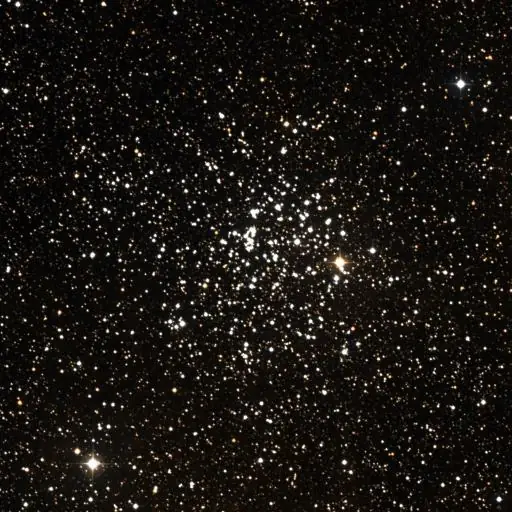
A cluster with an empty heart — swept clean, perhaps, by its own exploding stars.
About 160 million years ago, while dinosaurs roamed the Earth, a cloud of gas in what we now call Cassiopeia gave birth to M 52. Today this open cluster holds around 1,200 suns’ worth of stars, crowded around a dense core. Charles Messier added it to his list in 1774; some observers today call it the Scorpion Cluster.
Its stars are a restless lot. Among them is probably a supergiant, plus eighteen candidate slowly pulsating B stars — hot stars that gently swell and shrink — and a handful of other kinds of variable. Curiously, the cluster’s core holds almost no gas or dust. One idea is that supernovae early in its life blew the leftovers away.
M 52 (NGC 7654) is 5,100 light-years away: the light we see from it set off around 3080 BC, around the time the first circle of Stonehenge was raised.
Did you know?
- Dimmed on one side. Dust between us and M 52 is thicker across its southern half, so that side of the cluster looks fainter than it really is.
- A touch poorer than the Sun. M 52’s stars hold slightly less iron than the Sun does — a chemical fingerprint inherited from the cloud they formed in.
How big is it?
Born about 150 million years ago, when dinosaurs were rising and the supercontinent Pangaea was breaking apart. Light itself takes 19 years to cross it. Gaia has picked out 1,190 stars moving together through space as its members. That’s 4.5 times the distance from the Sun to the nearest star. Shrink our Solar System — the Sun and all eight planets — to the size of a coin, and M 52 would be 487 m across (5 football pitches end to end); the nearest star would be a football pitch away, and the Milky Way 2,520 km across.
A rich, compact open cluster in Cassiopeia; the faint Bubble Nebula (NGC 7635) lies about 35′ to its southwest.
When and where to see it
It is best placed in the evening sky around October, when it crosses the meridian at about 10 pm local time (around midnight in September). It can be seen from everywhere north of 28°S and never sets north of 28°N.
At its highest it stands 78° up from 50°N, 63° up from 35°N, 28° up from the equator, below the horizon from 35°S.
Facts
- Type
- Open cluster
- Constellation
- Cassiopeia
- Designations
- NGC 7654, Mel 243, Cr 455, Scorpion Cluster, Melotte 243, Collinder 455
- Magnitude
- 7.3
- Apparent size
- 13′
- Position
- RA 23h 24.8m, Dec +61° 36′ (J2000)
- Distance
- 5,100 light-years
- Discovered
- Charles Messier, 1774
Open AstroPilot to see when M 52 (NGC 7654) is highest tonight from your location, how easy it is with your telescope or binoculars, and an eyepiece view.