Whirlpool Galaxy (M 51)
Whirlpool Galaxy (M 51) is a galaxy in the constellation Canes Venatici, magnitude 8.4, 14′ × 12′ across.
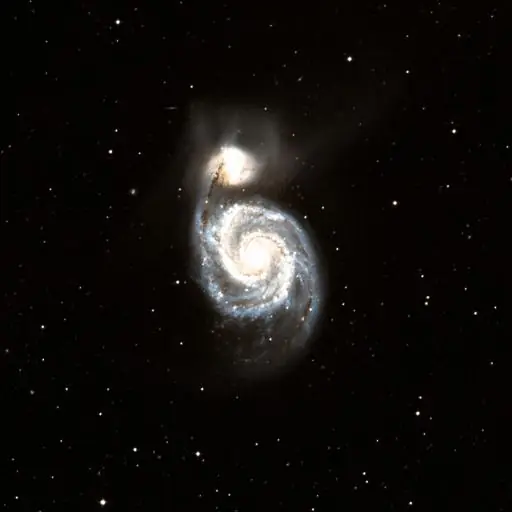
The first galaxy ever seen as a spiral — sketched by hand in 1845, and still being reshaped by its neighbour.
In 1845, at Birr Castle in Ireland, William Parsons, 3rd Earl of Rosse, turned his giant 72-inch reflector — the “Leviathan” — on a glow Charles Messier had found in 1773. He saw what no one had seen before: curving arms winding out from a bright core. M 51 became the first “nebula” known to have a spiral shape. Nobody yet knew it was a separate galaxy; that proof had to wait for Edwin Hubble.
Those arms are no accident. Its smaller companion, NGC 5195, seems to have plunged through M 51’s disc some 500 to 600 million years ago, then crossed it again between 50 and 100 million years ago. That close encounter is thought to have stirred up the bold, star-forming arms that make this a textbook spiral galaxy. Radio maps show the two galaxies are still joined by gas.
Whirlpool Galaxy (M 51) is 26 million light-years away: the light we see from it set off about 26 million years ago, when the Himalayas and the Alps were rising.
Did you know?
- Three supernovae in 17 years. Stars exploded here in 1994, 2005 and 2011. The 2011 one surprised experts: its star was probably a yellow supergiant, not the red or blue supergiants thought to be the usual culprits.
- Two stars become one. In 2019 a flare in M 51 turned out to be a luminous red nova — a rare outburst thought to come from two stars merging. The star had been hidden by dust, visible only in infrared archives.
- Hubble’s famous portrait. In 2005 the Hubble Heritage team assembled a picture of M 51 more than 11,000 pixels wide. It became one of Hubble’s best-known pictures; the James Webb Space Telescope added its own infrared view in 2022.
How big is it?
About as wide as our Milky Way. Light itself takes 100,000 years to cross it. Shrink it to the length of a football pitch and our whole Solar System would be smaller than a bacterium.
The classic face-on spiral, interacting with its smaller companion NGC 5195. It was the first galaxy whose spiral structure was recognized (Lord Rosse, 1845), and its arms can be glimpsed in an 8-inch telescope under dark skies.
When and where to see it
It is best placed in the evening sky around May, when it crosses the meridian at about 10 pm local time (around midnight in April). It can be seen from everywhere north of 43°S and never sets north of 43°N.
At its highest it stands 87° up from 50°N, 78° up from 35°N, 43° up from the equator, 8° up from 35°S.
Facts
- Type
- Galaxy
- Constellation
- Canes Venatici
- Designations
- M 51, NGC 5194
- Magnitude
- 8.4
- Apparent size
- 14′ × 12′
- Position
- RA 13h 29.9m, Dec +47° 12′ (J2000)
- Distance
- 26 million light-years
- Discovered
- Charles Messier, 1773
Open AstroPilot to see when Whirlpool Galaxy (M 51) is highest tonight from your location, how easy it is with your telescope or binoculars, and an eyepiece view.