M 50 (NGC 2323)
M 50 (NGC 2323) is an open cluster in the constellation Monoceros, magnitude 5.9, 16′ across.
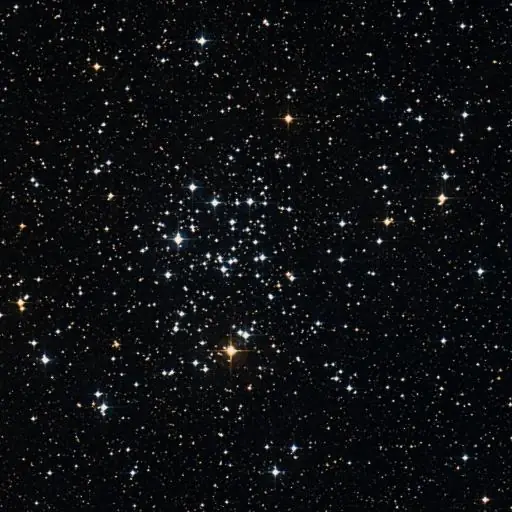
A heart-shaped cluster that turned out, in 2025, to be two clusters in one.
Giovanni Domenico Cassini, the astronomer famous for his work on Saturn, recorded this cluster before 1711. Six decades later Charles Messier came across it again in 1772, while following a comet — the one now known as Biela’s Comet.
Its 500-odd stars are about 140 million years old, young enough that most are still in the prime of life. Yet two have already died, leaving unusually heavy white dwarfs behind: they must have begun as hefty stars that lived fast and burned out first.
For centuries M 50 was treated as a single open cluster. In 2025 astronomers found it is really two sub-clusters side by side, NGC 2323-a and NGC 2323-b — making it a binary cluster.
M 50 (NGC 2323) is 3,100 light-years away: the light we see from it set off around 1080 BC, 250 years after Tutankhamun was buried in the Valley of the Kings.
Did you know?
- A Cretaceous birthday. When M 50’s stars formed, about 140 million years ago, dinosaurs ruled the Earth and flowering plants had not yet spread across it.
- Odd ones out. Two of its stars are chemically peculiar, with strange mixtures of elements in their outer layers that set them apart from their siblings.
How big is it?
Born about 130 million years ago, when dinosaurs still walked the Earth. Light itself takes 14 years to cross it. Gaia has picked out 788 stars moving together through space as its members. That’s 3.4 times the distance from the Sun to the nearest star. Shrink our Solar System — the Sun and all eight planets — to the size of a coin, and M 50 would be 364 m across (3 football pitches end to end); the nearest star would be a football pitch away, and the Milky Way 2,520 km across.
A bright open cluster in Monoceros, often described as heart-shaped, about a third of the way from Sirius to Procyon.
When and where to see it
It is best placed in the evening sky around February, when it crosses the meridian at about 10 pm local time (around midnight in January). It can be seen from everywhere south of 82°N and never sets south of 82°S.
At its highest it stands 32° up from 50°N, 47° up from 35°N, 82° up from the equator, 63° up from 35°S.
Facts
- Type
- Open cluster
- Constellation
- Monoceros
- Designations
- NGC 2323, Mel 58, Cr 124, Heart-Shaped Cluster, Melotte 58, Collinder 124
- Magnitude
- 5.9
- Apparent size
- 16′
- Position
- RA 7h 2.7m, Dec −8° 22′ (J2000)
- Distance
- 3,100 light-years
- Discovered
- Giovanni Domenico Cassini, 1711, Recorded before 1711; Messier found it again in 1772
Open AstroPilot to see when M 50 (NGC 2323) is highest tonight from your location, how easy it is with your telescope or binoculars, and an eyepiece view.