M 48 (NGC 2548)
M 48 (NGC 2548) is an open cluster in the constellation Hydra, magnitude 5.5, 54′ across.
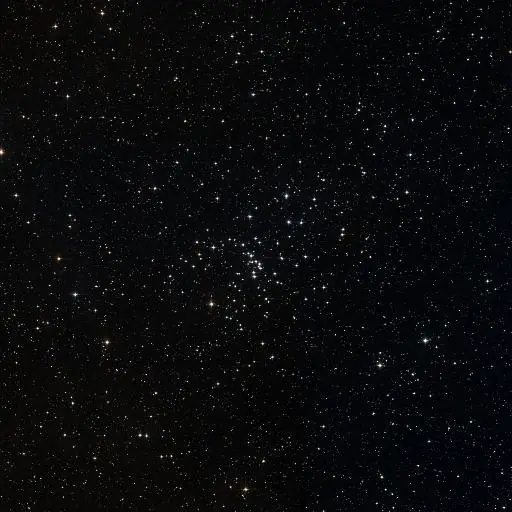
A cluster Messier put in the wrong place — middle-aged, lumpy, and quietly splitting into three.
Charles Messier found this cluster in 1771, but the declination he wrote down was five degrees off, so for years there was nothing at the spot he gave. Some histories credit Caroline Herschel instead, who found it in 1783. Her nephew John Herschel was smitten, calling it “a superb cluster which fills the whole field”.
At roughly 400 to 450 million years old, M 48 is middle-aged for an open cluster: older than the Pleiades, younger than the Hyades. It holds at least 438 stars, about 2,400 suns’ worth of mass in all. Its shape is broken and lumpy, perhaps from tugs by the Milky Way’s disc, and its stars now fall into three groups, each drifting its own way.
M 48 (NGC 2548) is 2,400 light-years away: the light we see from it set off around 380 BC, around the time the Parthenon was dedicated in Athens.
Did you know?
- Two clocks agree. Astronomers dated M 48 two ways: from how far its stars have evolved, and from how fast they spin, since stars slow down as they age. Both methods give about 400–450 million years.
- Before the first footsteps. When M 48’s stars formed, around 400–450 million years ago, no animal with a backbone had yet crawled out of the sea onto land.
How big is it?
Born about 390 million years ago, when the first plants and animals were moving onto land. Light itself takes 38 years to cross it. Gaia has picked out 778 stars moving together through space as its members. That’s 8.9 times the distance from the Sun to the nearest star. Shrink our Solar System — the Sun and all eight planets — to the size of a coin, and M 48 would be 951 m across (9 football pitches end to end); the nearest star would be a football pitch away, and the Milky Way 2,520 km across.
A large open cluster in Hydra, faintly visible to the naked eye from dark sites and well framed by binoculars.
When and where to see it
It is best placed in the evening sky around February, when it crosses the meridian at about 10 pm local time (around midnight in January). It can be seen from everywhere south of 84°N and never sets south of 84°S.
At its highest it stands 34° up from 50°N, 49° up from 35°N, 84° up from the equator, 61° up from 35°S.
Facts
- Type
- Open cluster
- Constellation
- Hydra
- Designations
- NGC 2548, Mel 85, Cr 179, Melotte 85, Collinder 179
- Magnitude
- 5.5
- Apparent size
- 54′
- Position
- RA 8h 13.7m, Dec −5° 45′ (J2000)
- Distance
- 2,400 light-years
- Discovered
- Charles Messier, 1771, Messier’s position was wrong; sometimes credited to Caroline Herschel (1783)
Open AstroPilot to see when M 48 (NGC 2548) is highest tonight from your location, how easy it is with your telescope or binoculars, and an eyepiece view.