M 47 (NGC 2422)
M 47 (NGC 2422) is an open cluster in the constellation Puppis, magnitude 4.4, 30′ across.
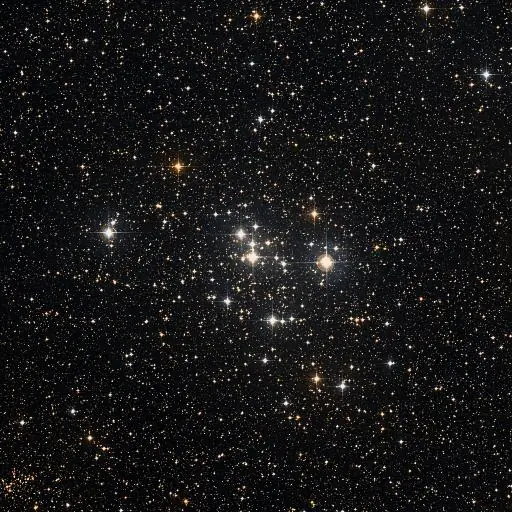
The Messier object that went missing for nearly two centuries — all because of two swapped signs.
Charles Messier saw this cluster in 1771 and carefully recorded its position, measured from the star 2 Puppis. Then, on paper, it vanished. Anyone who looked where he said found nothing, and M 47 joined the list of “lost” Messier objects. In 1959 the Canadian astronomer T. F. Morris cracked it: swap the plus and minus signs in Messier’s note and the position lands right on a bright cluster.
Messier was not even the first to see it. The Sicilian astronomer Giovanni Battista Hodierna had recorded it before 1654, and Caroline Herschel later found it on her own. The open cluster itself is young and lively: around 500 stars, led by hot blue-white B-type stars, with a few red giants adding a touch of colour.
M 47 (NGC 2422) is 1,500 light-years away: the light we see from it set off around AD 530, around the time the Hagia Sophia was completed in Constantinople.
Did you know?
- Born in the age of dinosaurs. M 47’s stars began shining about 78 million years ago, when dinosaurs still walked the Earth — some 12 million years before the asteroid impact that ended their reign.
- A spinning, shedding star. Its brightest member, HD 60855, is a Be star: a hot, fast-spinning star that flings gas out into a disc around its middle.
- Two numbers for one cluster. The tangled history left its mark: M 47 carries two entries in the New General Catalogue, NGC 2422 and NGC 2478.
How big is it?
Born about 110 million years ago, when dinosaurs still walked the Earth. Light itself takes 13 years to cross it. Gaia has picked out 1,129 stars moving together through space as its members. That’s 3.1 times the distance from the Sun to the nearest star. Shrink our Solar System — the Sun and all eight planets — to the size of a coin, and M 47 would be 330 m across (3 football pitches end to end); the nearest star would be a football pitch away, and the Milky Way 2,520 km across.
A bright, coarse open cluster near M46, visible to the naked eye under dark skies; its few dozen bright stars contrast with M46's rich, faint swarm in the same binocular field.
When and where to see it
It is best placed in the evening sky around February, when it crosses the meridian at about 10 pm local time (around midnight in January). It can be seen from everywhere south of 76°N and never sets south of 76°S.
At its highest it stands 26° up from 50°N, 41° up from 35°N, 76° up from the equator, 69° up from 35°S.
Facts
- Type
- Open cluster
- Constellation
- Puppis
- Designations
- NGC 2422, NGC 2478, Mel 68, Cr 152, Melotte 68, Collinder 152
- Magnitude
- 4.4
- Apparent size
- 30′
- Position
- RA 7h 36.6m, Dec −14° 29′ (J2000)
- Distance
- 1,500 light-years
- Discovered
- Giovanni Battista Hodierna, 1654, Recorded before 1654; Messier found it again in 1771
Open AstroPilot to see when M 47 (NGC 2422) is highest tonight from your location, how easy it is with your telescope or binoculars, and an eyepiece view.