M 46 (NGC 2437)
M 46 (NGC 2437) is an open cluster in the constellation Puppis, magnitude 6.0, 27′ across.
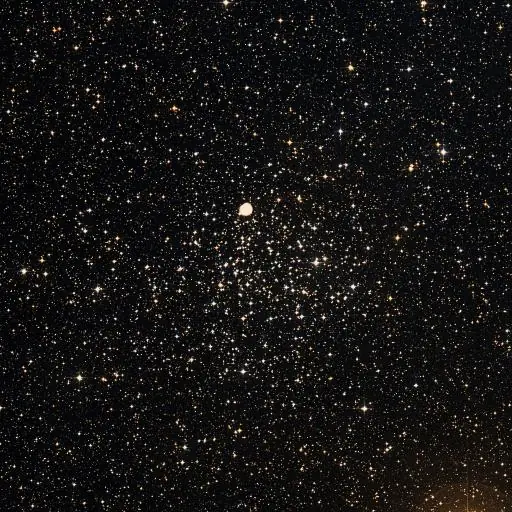
A family of five hundred suns, a quarter of a billion years old — with a stranger posing in the family photo.
When the stars of M 46 were born, roughly 250 million years ago, Earth’s continents were still jammed together as the supercontinent Pangaea. Ever since, this open cluster of about 500 stars has travelled around the Milky Way as one family, with a combined mass of around 450 suns. Charles Messier logged it in 1771, and more than a century later John Dreyer summed it up as “very bright, very rich, very large”.
The family is slowly sorting itself out. In infrared light the cluster looks larger than in visible light — a sign that heavier stars are settling towards the middle while fainter, redder ones drift outwards. A thin trail of stars to the south and west may be a tidal tail, pulled loose in some past encounter.
M 46 (NGC 2437) is 5,100 light-years away: the light we see from it set off around 3080 BC, around the time the first circle of Stonehenge was raised.
Did you know?
- The nebula that really belongs. The planetary nebula that seems to sit inside M 46 is probably just a chance alignment. But the star lighting up the bipolar Calabash Nebula shares the cluster’s motion and distance — a true member of the family.
- Not a twin. M 47, about a degree away, looks like M 46’s sibling. It isn’t: M 47 is much younger and much closer to us, so the pairing on the sky is pure coincidence.
How big is it?
Born about 300 million years ago, when the first plants and animals were moving onto land. Light itself takes 40 years to cross it. Gaia has picked out 2,577 stars moving together through space as its members. That’s 9.4 times the distance from the Sun to the nearest star. Shrink our Solar System — the Sun and all eight planets — to the size of a coin, and M 46 would be 1.01 km across (a 10-minute walk); the nearest star would be a football pitch away, and the Milky Way 2,520 km across.
A rich, even cluster of hundreds of faint stars. The planetary nebula NGC 2438 appears on its northern side, though it is probably unrelated to the cluster.
When and where to see it
It is best placed in the evening sky around February, when it crosses the meridian at about 10 pm local time (around midnight in January). It can be seen from everywhere south of 75°N and never sets south of 75°S.
At its highest it stands 25° up from 50°N, 40° up from 35°N, 75° up from the equator, 70° up from 35°S.
Facts
- Type
- Open cluster
- Constellation
- Puppis
- Designations
- NGC 2437, Mel 75, Cr 159, Melotte 75, Collinder 159
- Magnitude
- 6.0
- Apparent size
- 27′
- Position
- RA 7h 41.8m, Dec −14° 49′ (J2000)
- Distance
- 5,100 light-years
- Discovered
- Charles Messier, 1771
Open AstroPilot to see when M 46 (NGC 2437) is highest tonight from your location, how easy it is with your telescope or binoculars, and an eyepiece view.