Pleiades (M 45)
Pleiades (M 45) is an open cluster in the constellation Taurus, magnitude 1.6, 1.8° across.
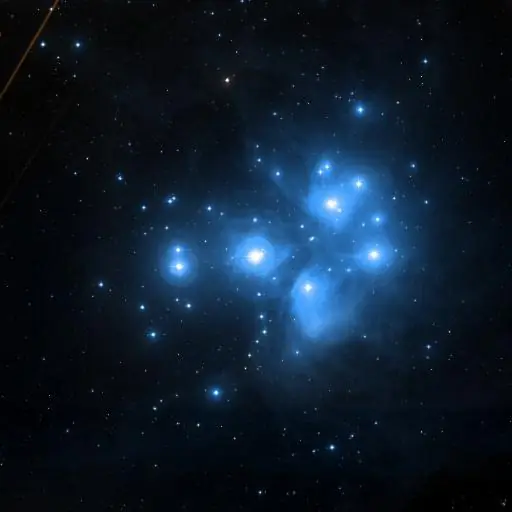
Seven Sisters to the Greeks, Subaru in Japan, Matariki to the Māori — the most famous star cluster of all.
Few things in the sky have meant so much to so many people. The Pleiades appear on the Nebra sky disc, a Bronze Age artefact from Germany dated to around 1600 BC — probably the oldest known picture of them. Their name likely comes from the Greek for “to sail”, because their rising marked the start of the sailing season in the Mediterranean.
Myths around the world speak of seven sisters, and often explain why only six can be seen. Some scientists suggest these stories may reach back as far as 100,000 BC, when the star Pleione sat farther from Atlas and was easier to see on its own.
The open cluster itself is young: its hot blue stars formed within the last 100 million years, probably from a compact knot of gas that once resembled the Orion Nebula. It is the nearest Messier object to Earth and holds over 1,000 stars. In about 250 million years, the pull of its galactic surroundings will scatter them.
Pleiades (M 45) is 440 light-years away: the light we see from it set off around 1585, 25 years before Galileo first turned a telescope to the sky.
Did you know?
- Where the year began. Around 2330 BC the Pleiades marked the spring equinox point. Ancient Indian and Arab calendars began with them, and a Babylonian list of stars along the Moon’s path starts with them too.
- Clustering together. In Japan the cluster is Subaru, from a verb meaning “to cluster together”. The car maker named after it shows the stars on its badge.
- Golden Gate of the Ecliptic. With the Hyades, the Pleiades form the Golden Gate of the Ecliptic: the yearly path of the Sun across our sky runs between the two clusters.
How big is it?
Born about 120 million years ago, when dinosaurs still walked the Earth. Light itself takes 14 years to cross it. Gaia has picked out 1,721 stars moving together through space as its members. That’s 3.3 times the distance from the Sun to the nearest star. Shrink our Solar System — the Sun and all eight planets — to the size of a coin, and the Pleiades would be 355 m across (3 football pitches end to end); the nearest star would be a football pitch away, and the Milky Way 2,520 km across.
The Seven Sisters, the brightest and most famous star cluster, about 440 light-years away. Binoculars show dozens of blue-white stars; the nebulosity around them, a dust cloud the cluster is passing through, is faint to the eye but shines in photographs.
When and where to see it
It is best placed in the evening sky around December, when it crosses the meridian at about 10 pm local time (around midnight in November). It can be seen from everywhere north of 66°S and never sets north of 66°N.
At its highest it stands 64° up from 50°N, 79° up from 35°N, 66° up from the equator, 31° up from 35°S.
Facts
- Type
- Open cluster
- Constellation
- Taurus
- Designations
- M 45, Mel 22, Seven Sisters, Subaru, Melotte 22
- Magnitude
- 1.6
- Apparent size
- 1.8°
- Position
- RA 3h 47.5m, Dec +24° 6′ (J2000)
- Distance
- 440 light-years
- Discovered
- Known since prehistory; shown on the Nebra sky disc around 1600 BC
Open AstroPilot to see when Pleiades (M 45) is highest tonight from your location, how easy it is with your telescope or binoculars, and an eyepiece view.