Beehive Cluster (M 44)
Beehive Cluster (M 44) is an open cluster in the constellation Cancer, magnitude 3.7, 1.6° across.
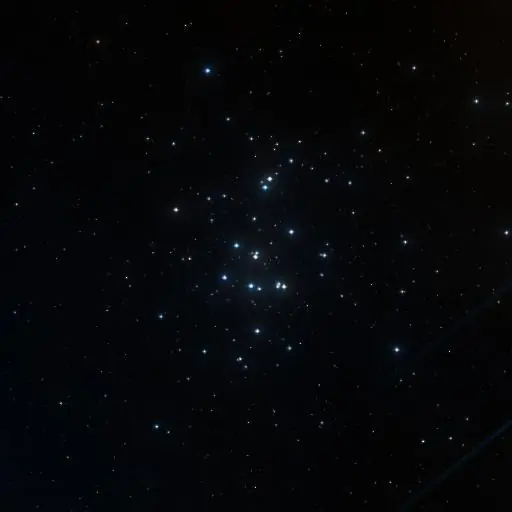
A manger to the Greeks, a ghost to the Chinese — and home to planets around Sun-like stars.
For thousands of years people have looked at this faint misty patch and wondered. The Greek poet Aratus called it Achlus, the “Little Mist”, in the 3rd century BC, and Hipparchus listed it as Nephelion, the “Little Cloud”. Greeks and Romans pictured a manger — Praesepe — with two donkeys, the neighbouring stars Asellus Borealis and Asellus Australis, feeding from it. Chinese skywatchers saw a ghost riding in a carriage, and gave it a grimmer name: the “Exhalation of Piled-up Corpses”.
It was among the first things Galileo studied with his telescope, and he counted 40 stars in it. We now know it is an open cluster of at least 1,000 stars, about 600 million years old. Its age and motion match those of the Hyades, so the two clusters may share a common origin.
Beehive Cluster (M 44) is 600 light-years away: the light we see from it set off around 1425, 30 years before Gutenberg printed his Bible.
Did you know?
- Planets around Sun-like stars. In 2012, two hot Jupiters were found in the Beehive — the first planets seen orbiting Sun-like stars in a star cluster. In 2016 one of the systems, Pr0211, turned out to have a second planet.
- A padded catalogue?. Messier added the Beehive in 1769, though no one would mistake it for a comet. He may have wanted his list to outgrow that of his rival Lacaille, whose 1755 catalogue had 42 objects.
- Missing brown dwarfs. Brown dwarfs are rare in the Beehive, probably because tides from the galaxy have stripped them away from the cluster’s outer halo.
How big is it?
Born about 680 million years ago, when there were no animals on Earth at all. Light itself takes 17 years to cross it. Gaia has picked out 1,314 stars moving together through space as its members. That’s 3.9 times the distance from the Sun to the nearest star. Shrink our Solar System — the Sun and all eight planets — to the size of a coin, and the Beehive Cluster would be 418 m across (4 football pitches end to end); the nearest star would be a football pitch away, and the Milky Way 2,520 km across.
Praesepe, the Beehive: a large open cluster visible to the naked eye as a misty patch in Cancer, about 600 light-years away. Binoculars resolve dozens of stars and frame it best.
When and where to see it
It is best placed in the evening sky around February, when it crosses the meridian at about 10 pm local time (around midnight in January). It can be seen from everywhere north of 70°S and never sets north of 70°N.
At its highest it stands 60° up from 50°N, 75° up from 35°N, 70° up from the equator, 35° up from 35°S.
Facts
- Type
- Open cluster
- Constellation
- Cancer
- Designations
- M 44, NGC 2632, Mel 88, Cr 189, Beehive, Praesepe Cluster, Praesepe, Melotte 88, Collinder 189
- Magnitude
- 3.7
- Apparent size
- 1.6°
- Position
- RA 8h 40.4m, Dec +19° 40′ (J2000)
- Distance
- 600 light-years
- Discovered
- Known since antiquity; Aratus called it the “Little Mist”
Open AstroPilot to see when Beehive Cluster (M 44) is highest tonight from your location, how easy it is with your telescope or binoculars, and an eyepiece view.