De Mairan's Nebula (M 43)
De Mairan's Nebula (M 43) is an emission nebula in the constellation Orion, magnitude 9.0, 20′ × 15′ across.
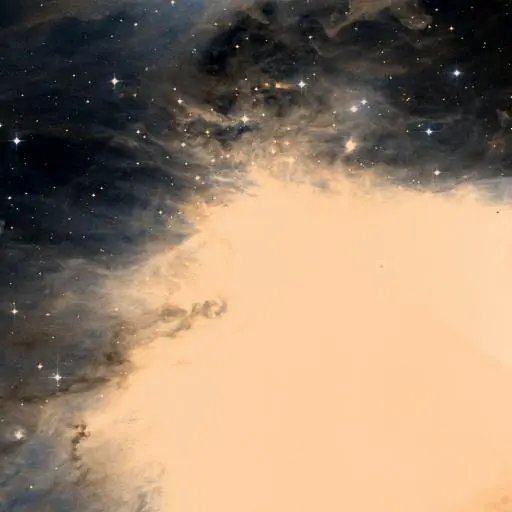
A nebula that looks separate but is really part of Orion’s great star factory, lit by a four-star system.
The French scientist Jean-Jacques d’Ortous de Mairan found this small nebula some time before 1731, and Charles Messier catalogued it in 1769. It looks like a separate object, but it is physically part of the Orion Nebula, cut off only by a dense lane of dust — and both belong to the much larger Orion molecular cloud complex.
Its glow is a roundish bubble of hydrogen gas, ionised by NU Orionis, a system of four stars at its centre. Unlike the Trapezium stars that light the main nebula, NU Orionis is not hot enough to make oxygen glow strongly, so this emission nebula shines mostly in the red light of hydrogen.
Dark lanes of dust wind across it and join the dust between it and M 42. To some eyes they look like smoke rising from a chimney, or bold brushstrokes in a watercolour.
De Mairan's Nebula (M 43) is 1,300 light-years away: the light we see from it set off around AD 730, 75 years before Charlemagne was crowned emperor.
Did you know?
- A four-star lamp. NU Orionis, the star system lighting M 43, is a quadruple: four stars bound together, whose ultraviolet light makes the surrounding hydrogen glow.
- A man of many interests. De Mairan is also remembered for a 1729 experiment showing that mimosa plants keep opening and closing their leaves on a daily rhythm even in darkness — an early glimpse of biological clocks.
How big is it?
1.8 times the distance from the Sun to the nearest star. Light itself takes 7.6 years to cross it. Shrink our Solar System — the Sun and all eight planets — to the size of a coin, and De Mairan's Nebula would be 191 m across (2 football pitches end to end); the nearest star would be a football pitch away, and the Milky Way 2,520 km across.
A comma-shaped part of the Orion Nebula complex, separated from M42 by a dark lane and lit by the young star NU Orionis at its center.
When and where to see it
It is best placed in the evening sky around January, when it crosses the meridian at about 10 pm local time (around midnight in December). It can be seen from everywhere south of 85°N and never sets south of 85°S.
At its highest it stands 35° up from 50°N, 50° up from 35°N, 85° up from the equator, 60° up from 35°S.
Facts
- Type
- Emission nebula
- Constellation
- Orion
- Designations
- M 43, NGC 1982, Mairan's Nebula
- Magnitude
- 9.0
- Apparent size
- 20′ × 15′
- Position
- RA 5h 35.5m, Dec −5° 16′ (J2000)
- Distance
- 1,300 light-years
- Discovered
- Jean-Jacques d’Ortous de Mairan, 1731, Found some time before 1731
Open AstroPilot to see when De Mairan's Nebula (M 43) is highest tonight from your location, how easy it is with your telescope or binoculars, and an eyepiece view.